Cyclin D3 Recombinant Rabbit mAb (一抗) - WB | Bioss
Rrmab?兔单抗
货号:bsm-52047R
产品详情
相关标记
相关产品
相关文献
常见问题
概述
产品编号
bsm-52047R
产品类型
重组兔单抗
英文名称
Cyclin D3 Recombinant Rabbit mAb
中文名称
周期素D3兔单克隆抗体
英文别名
9230106B05Rik; CCND3_BOVIN; CCND3; CCND3_HUMAN; CCND3_MOUSE; Cyl-3; CCND3_RAT; cyclin D3
抗体来源
Rabbit
免疫原
Recombinant human Cyclin D3 protein, around C-terminal 200aa
亚型
IgG
性状
Liquid
纯化方法
affinity purified by Protein A
克隆类型
Recombinant
克隆号
4A8
理论分子量
32 kDa
检测分子量
31 kDa
浓度
1mg/ml
储存液
0.01M TBS (pH7.4) with 1% BSA, 0.02% Proclin300 and 50% Glycerol.
研究领域
SWISS
Gene ID
保存条件
Shipped at 4℃. Store at -20℃ for one year. Avoid repeated freeze/thaw cycles.
注意事项
This product as supplied is intended for research use only, not for use in human, therapeutic or diagnostic applications.
数据库链接
产品介绍
细胞周期素是周期素依赖激酶的调节因子,不同的细胞周期素控制着细胞周期中不同的特定阶段。
周期素D3与周期素D1和D2一样,为细胞周期中G1期进入S期的一个重要调控因子,通过激活CdK4或CdK6等作用,促进DNA合成,加速细胞增殖,主要用于B细胞淋巴瘤、乳腺癌、头颈部鳞癌、食道癌、肝癌和肺癌等恶性肿瘤的研究。
周期素D3与周期素D1和D2一样,为细胞周期中G1期进入S期的一个重要调控因子,通过激活CdK4或CdK6等作用,促进DNA合成,加速细胞增殖,主要用于B细胞淋巴瘤、乳腺癌、头颈部鳞癌、食道癌、肝癌和肺癌等恶性肿瘤的研究。
背景资料
The protein encoded by this gene belongs to the highly conserved cyclin family, whose members are characterized by a dramatic periodicity in protein abundance through the cell cycle. Cyclins function as regulators of CDK kinases. Different cyclins exhibit distinct expression and degradation patterns which contribute to the temporal coordination of each mitotic event. This cyclin forms a complex with and functions as a regulatory subunit of CDK4 or CDK6, whose activtiy is required for cell cycle G1/S transition. This protein has been shown to interact with and be involved in the phosphorylation of tumor suppressor protein Rb. The CDK4 activity associated with this cyclin was reported to be necessary for cell cycle progression through G2 phase into mitosis after UV radiation. Several transcript variants encoding different isoforms have been found for this gene. [provided by RefSeq, Oct 2008].
基因名
CCND3
蛋白名
G1/S-specific cyclin-D3
亚基
Interacts with the CDK4 and CDK6 protein kinases to form a serine/threonine kinase holoenzyme complex. The cyclin subunit imparts substrate specificity to the complex. Interacts with ATF5. Interacts with EIF3K. Component of the ternary complex cyclin D/CDK4/CDKN1B required for nuclear translocation and modulation of CDK4-mediated kinase activity. Can form similar complexes with either CDKN1A or CDKN2A.
亚细胞定位
Nucleus. Cytoplasm. Membrane. Note=Cyclin D-CDK4 complexes accumulate at the nuclear membrane and are then translocated to the nucleus through interaction with KIP/CIP family members.
组织特异性
翻译后修饰
Polyubiquitinated by the SCF(FBXL2) complex, leading to proteasomal degradation.
相似性
Belongs to the cyclin family. Cyclin D subfamily.
Contains 1 cyclin N-terminal domain.
Contains 1 cyclin N-terminal domain.
功能
Regulatory component of the cyclin D3-CDK4 (DC) complex that phosphorylates and inhibits members of the retinoblastoma (RB) protein family including RB1 and regulates the cell-cycle during G(1)/S transition. Phosphorylation of RB1 allows dissociation of the transcription factor E2F from the RB/E2F complex and the subsequent transcription of E2F target genes which are responsible for the progression through the G(1) phase. Hypophosphorylates RB1 in early G(1) phase. Cyclin D-CDK4 complexes are major integrators of various mitogenenic and antimitogenic signals. Also substrate for SMAD3, phosphorylating SMAD3 in a cell-cycle-dependent manner and repressing its transcriptional activity. Component of the ternary complex, cyclin D3/CDK4/CDKN1B, required for nuclear translocation and activity of the cyclin D-CDK4 complex.
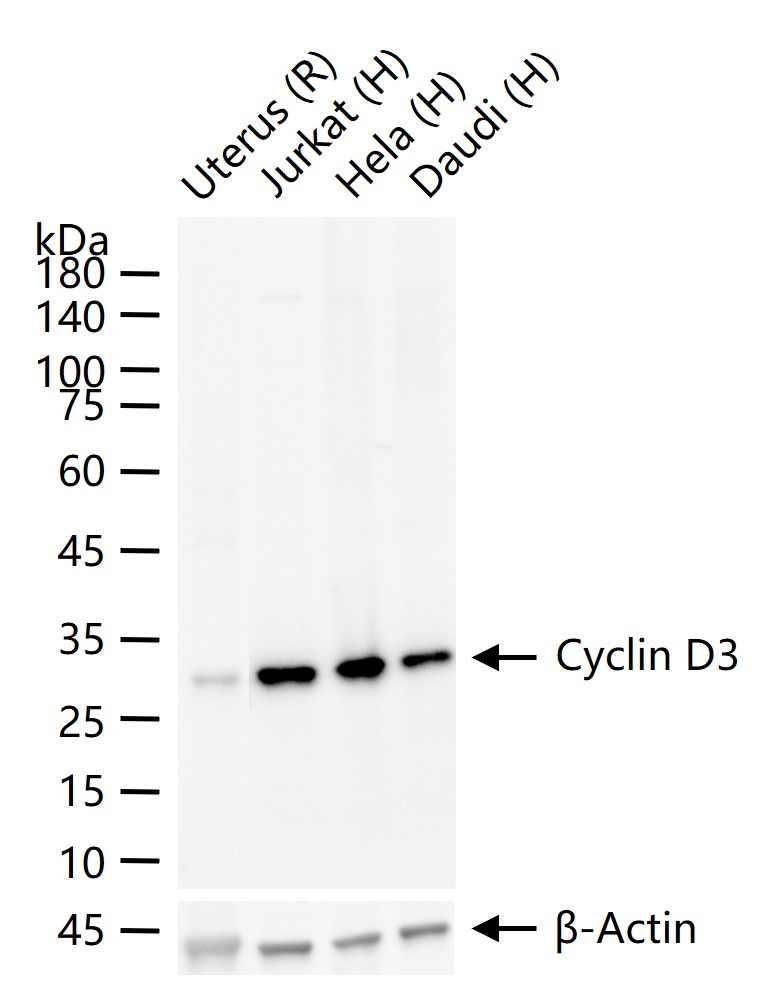
产品应用
| 应用 | 已检合格种属 | 预测种属 | 推荐稀释比例 |
|---|---|---|---|
| WB | Human, Rat | 1:500-2000 |
交叉反应
交叉反应: Human, Rat
相关产品
暂无相关产品
同靶标产品
相关文献
提示: 发表研究结果有使用 bsm-52047R 时请让我们知道,以便我们可以引用参考文章。作为回馈,资料提供者将获得我们送上的小礼品。