GCNT2 Rabbit pAb (一抗) - WB | Bioss
货号:bs-13316R
产品详情
相关标记
相关产品
相关文献
常见问题
概述
产品编号
bs-13316R
产品类型
农牧业/家禽抗体
英文名称
GCNT2 Rabbit pAb
中文名称
β1-6 N-乙酰氨基葡萄糖转移酶2抗体
英文别名
GNT2A_HUMAN; GCNT2; N-acetylglucosaminyltransferase; I-branching enzyme; IGNT; 2.4.1.150; GCNT5; II; NACGT1; GCNT2_MOUSE; Large I antigen-forming beta-1,6-N-acetylglucosaminyltransferase; glucosaminyl (N-acetyl) transferase 2 (I blood group); glucosaminyl (N-acetyl) transferase 5; cataract, congenital; glucosaminyl (N-acetyl) transferase 2, I-branching enzyme (I blood group); Ii blood group; unassigned linkage group 3
抗体来源
Rabbit
免疫原
KLH conjugated synthetic peptide derived from human GCNT2: 151-250/400
亚型
IgG
性状
Liquid
纯化方法
affinity purified by Protein A
克隆类型
Polyclonal
理论分子量
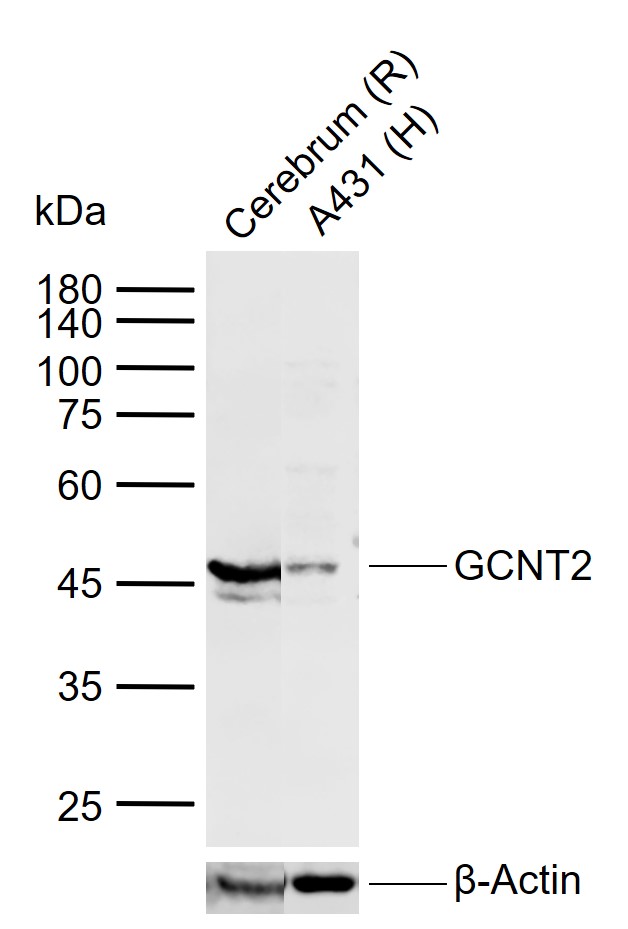
46 kDa
检测分子量
46 kDa
浓度
1mg/ml
储存液
0.01M TBS (pH7.4) with 1% BSA, 0.02% Proclin300 and 50% Glycerol.
研究领域
SWISS
Gene ID
保存条件
Shipped at 4℃. Store at -20℃ for one year. Avoid repeated freeze/thaw cycles.
注意事项
This product as supplied is intended for research use only, not for use in human, therapeutic or diagnostic applications.
数据库链接
背景资料
Belonging to the glycosyltransferase 14 family, GCNT2 (glucosaminyl (N-acetyl) transferase 2, I-branching enzyme (I blood group)), also known as II, N-acetylglucosaminyltransferase, IGNT, CCAT, ULG3, GCNT5, GCNT2C or NACGT1, is a 400 amino acid glycosyltransferase that localizes to the Golgi apparatus. Other members of the glycosyltransferase 14 family include GCNT1, GCNT3, GCNT4, GCNT6 and GCNT7. A single-pass type II membrane protein, GCNT2 functions as a branching enzyme known as beta-1,6-N-acetylglucosaminyltransferase, which converts fetal i antigen to adult I antigen in erythrocytes during embryonic development. With expression levels increasing significantly during oncogenesis and development, GCNT2 is found at highest levels in adult prostate and fetal brain, and is found at low levels in heart, small intestine, colon, brain, pancreas and kidney.
产品应用
| 应用 | 已检合格种属 | 预测种属 | 推荐稀释比例 |
|---|---|---|---|
| WB | Human, Rat | Mouse, Horse | 1:500-2000 |
交叉反应
交叉反应: Human, Rat (predicted: Mouse, Horse)
相关产品
暂无相关产品
靶标
基因名
GCNT2
蛋白名
N-acetyllactosaminide beta-1, 6-N-acetylglucosaminyl-transferase
亚细胞定位
Golgi apparatus membrane.
组织特异性
In the adult, highly expressed in prostate and to a lesser extent in small intestine and colon. Barely detected in heart, brain, kidney and pancreas. No expression in placenta, lung, liver, skeletal muscle, spleen, thymus, testis, ovary and peripheral blood leukocytes. In fetus, highly expressed in brain and to a lesser extent in lung and kidney. Barely detected in liver.
相似性
Belongs to the glycosyltransferase 14 family.
功能
GCNT2 is the I-branching enzyme, a beta-1,6-N-acetylglucosaminyltransferase that converts linear into branched poly-N-acetyllactosaminoglycans and is responsible for the conversion of fetal i antigen to adult I antigen in erythrocytes during embryonic development. Mutations in this gene have been associated with adult i blood group phenotype. Alternatively spliced transcript variants encoding 3 different isoforms have been described.
同靶标产品
相关文献
提示: 发表研究结果有使用 bs-13316R 时请让我们知道,以便我们可以引用参考文章。作为回馈,资料提供者将获得我们送上的小礼品。