HP | Haptoglobin Recombinant Rabbit mAb (一抗) - WB | Bioss
Rrmab?兔单抗
货号:bsm-63203R
产品详情
相关标记
相关产品
相关文献
常见问题
概述
产品编号
bsm-63203R
产品类型
重组兔单抗
英文名称
HP | Haptoglobin Recombinant Rabbit mAb
中文名称
结合珠蛋白/触珠蛋白重组兔单抗
英文别名
BP; HP2ALPHA2; HPA1S; HP-1; preHP2; Ba1-647; HPT_HUMAN; HP; Zonulin; HPT_MOUSE; HPT_RAT; Liver regeneration-related protein LRRG173; haptoglobin
抗体来源
Rabbit
免疫原
A synthesized peptide derived from human Haptoglobin: 390-406
亚型
IgG
性状
Liquid
纯化方法
affinity purified by Protein A
克隆类型
Recombinant
克隆号
5F3
理论分子量
45 kDa
检测分子量
43 kDa
储存液
0.01M TBS (pH7.4) with 1% BSA, 0.02% Proclin300 and 50% Glycerol.
SWISS
Gene ID
保存条件
Shipped at 4℃. Store at -20℃ for one year. Avoid repeated freeze/thaw cycles.
注意事项
This product as supplied is intended for research use only, not for use in human, therapeutic or diagnostic applications.
数据库链接
产品介绍
haptoglobin是一种酸性糖蛋白,属α2唾液酸糖蛋白,主要由肝脏合成,也可在脂肪细胞、皮肤、脾、肌肉、肺内等合成。
背景资料
As a result of hemolysis, hemoglobin is found to accumulate in the kidney and is secreted in the urine. Hemoglobin/haptoglobin complexes are rapidly cleared by the macrophage CD163 scavenger receptor expressed on the surface of liver Kupfer cells through an endocytic lysosomal degradation pathway.
基因名
HP
蛋白名
Haptoglobin
亚基
Tetramer of two alpha and two beta chains; disufide-linked. The Hemoglobin/haptoglobin complex is composed of a haptoglobin dimer bound to two hemoglobin alpha-beta dimers. Interacts with CD163.
亚细胞定位
Secreted.
组织特异性
Expressed by the liver and secreted in plasma.
疾病
Anhaptoglobinemia (AHP) [MIM:614081]: A condition characterized by the absence of the serum glycoprotein haptoglobin. Serum levels of haptoglobin vary among normal persons: levels are low in the neonatal period and in the elderly, differ by population, and can be influenced by environmental factors, such as infection. Secondary hypohaptoglobinemia can occur as a consequence of hemolysis, during which haptoglobin binds to free hemoglobin. Congenital haptoglobin deficiency is a risk factor for anaphylactic non-hemolytic transfusion reactions. Note=The disease is caused by mutations affecting the gene represented in this entry.
相似性
Belongs to the peptidase S1 family. Contains 1 peptidase S1 domain. Contains 2 Sushi (CCP/SCR) domains.
功能
As a result of hemolysis, hemoglobin is found to accumulate in the kidney and is secreted in the urine. Haptoglobin captures, and combines with free plasma hemoglobin to allow hepatic recycling of heme iron and to prevent kidney damage. Haptoglobin also acts as an Antimicrobial; Antioxidant, has antibacterial activity and plays a role in modulating many aspects of the acute phase response. Hemoglobin/haptoglobin complexes are rapidely cleared by the macrophage CD163 scavenger receptor expressed on the surface of liver Kupfer cells through an endocytic lysosomal degradation pathway.
Uncleaved haptoglogin, also known as zonulin, plays a role in intestinal permeability, allowing intercellular tight junction disassembly, and controlling the equilibrium between tolerance and immunity to non-self antigens.
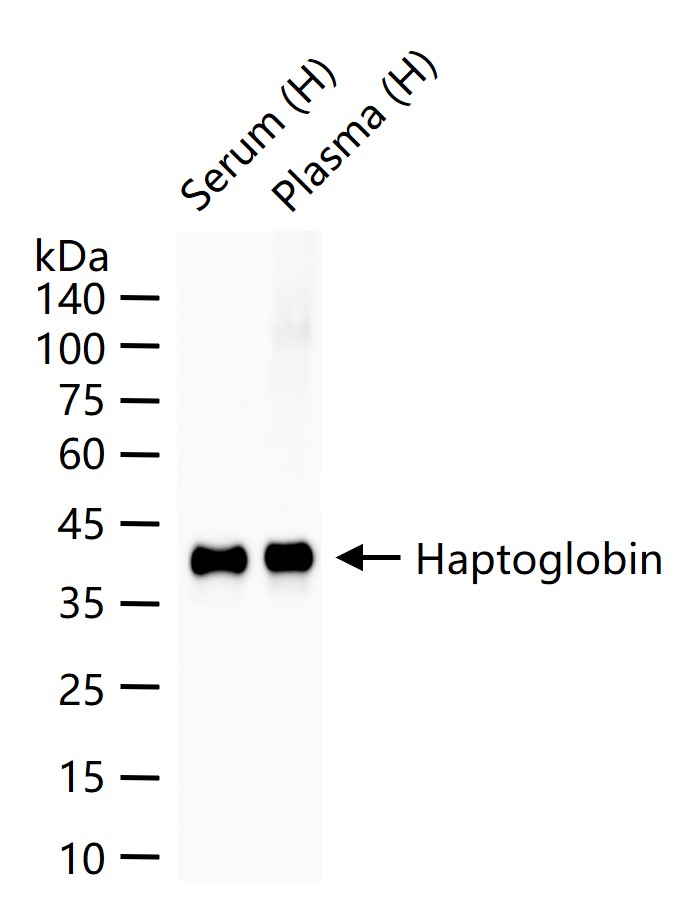
产品应用
| 应用 | 已检合格种属 | 预测种属 | 推荐稀释比例 |
|---|---|---|---|
| WB | Human | Mouse, Rat | 1:500-2000 |
交叉反应
交叉反应: Human (predicted: Mouse, Rat)
相关产品
暂无相关产品
同靶标产品
相关文献
提示: 发表研究结果有使用 bsm-63203R 时请让我们知道,以便我们可以引用参考文章。作为回馈,资料提供者将获得我们送上的小礼品。