C20orf186 Rabbit pAb (一抗) | Bioss
货号:bs-15102R
产品详情
相关标记
相关产品
相关文献
常见问题
概述
产品编号
bs-15102R
产品类型
宠物抗体、农牧业/家禽抗体
英文名称
C20orf186 Rabbit pAb
中文名称
20号染色体开放阅读框186抗体
英文别名
C20orf186; LPLUNC4; RY2G5; dJ726C3.5; BPIB4_HUMAN; BPIFB4; Ligand-binding protein RY2G5; Long palate, lung and nasal epithelium carcinoma-associated protein 4; BPIB4_RAT;
抗体来源
Rabbit
免疫原
KLH conjugated synthetic peptide derived from human C20orf186: 501-600/614
亚型
IgG
性状
Liquid
纯化方法
affinity purified by Protein A
克隆类型
Polyclonal
理论分子量
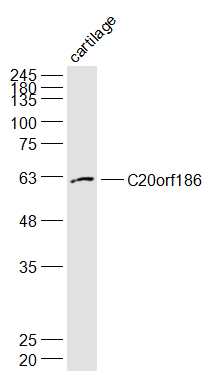
63 kDa
检测分子量
62 kDa
浓度
1mg/ml
储存液
0.01M TBS (pH7.4) with 1% BSA, 0.02% Proclin300 and 50% Glycerol.
SWISS
Gene ID
保存条件
Shipped at 4℃. Store at -20℃ for one year. Avoid repeated freeze/thaw cycles.
注意事项
This product as supplied is intended for research use only, not for use in human, therapeutic or diagnostic applications.
数据库链接
背景资料
LPLUNC4 is a 614 amino acid secreted protein that belongs to the BPI/LBP/PLUNC superfamily. Expressed in nasal tissue, LPLUNC4 has the capacity to recognize and bind specific classes of odorants serving as a primary defense mechanism in the mucosa. LPLUNC4 is encoded by a gene which maps to a BPI/LBP/PLUNC gene cluster on human chromosome 20. Comprising approximately 2% of the human genome, chromosome 20 contains nearly 63 million bases that encode over 600 genes, some of which are associated with Creutzfeldt-Jakob disease, amyotrophic lateral sclerosis, spinal muscular atrophy, ring chromosome 20 epilepsy syndrome and Alagille syndrome
产品应用
| 应用 | 已检合格种属 | 预测种属 | 推荐稀释比例 |
|---|---|---|---|
| WB | Mouse | Human, Rat, Dog, Horse | 1:500-2000 |
交叉反应
交叉反应: Mouse (predicted: Human, Rat, Dog, Horse)
相关产品
暂无相关产品
靶标
基因名
BPIFB4
蛋白名
BPI fold-containing family B member 4
亚细胞定位
Secreted (By similarity). Cytoplasm.
组织特异性
Expressed in nasal tissue.
相似性
Belongs to the BPI/LBP/Plunc superfamily. BPI/LBP family.
功能
May have the capacity to recognize and bind specific classes of odorants. May act as a carrier molecule, transporting odorants across the mucus layer to access receptor sites. May serve as a primary defense mechanism by recognizing and removing potentially harmful odorants or pathogenic microorganisms from the mucosa or clearing excess odorant from mucus to enable new odorant stimuli to be received (By similarity).
同靶标产品
相关文献
提示: 发表研究结果有使用 bs-15102R 时请让我们知道,以便我们可以引用参考文章。作为回馈,资料提供者将获得我们送上的小礼品。