RIPK1 | RIP1 Rabbit pAb (一抗) | Bioss
货号:bs-25588R
产品详情
相关标记
相关产品
相关文献
常见问题
概述
产品编号
bs-25588R
英文名称
RIPK1 | RIP1 Rabbit pAb
中文名称
丝氨酸苏氨酸激酶1受体相互作用蛋白抗体
英文别名
AIEFL; IMD57; RIP; RIP-1; RIP1; D330015H01Rik; Rinp; RIPK1_HUMAN; RIPK1; Cell death protein RIP; Receptor-interacting protein 1 (RIP-1); 2.7.11.1; RIPK1_MOUSE; receptor interacting serine/threonine kinase 1; receptor (TNFRSF)-interacting serine-threonine kinase 1; receptor-interacting protein kinase 1
抗体来源
Rabbit
免疫原
KLH conjugated synthetic peptide derived from human RIPK1: 381-480/671
亚型
IgG
性状
Liquid
纯化方法
affinity purified by Protein A
克隆类型
Polyclonal
浓度
1mg/ml
储存液
0.01M TBS (pH7.4) with 1% BSA, 0.02% Proclin300 and 50% Glycerol.
SWISS
Gene ID
保存条件
Shipped at 4℃. Store at -20℃ for one year. Avoid repeated freeze/thaw cycles.
注意事项
This product as supplied is intended for research use only, not for use in human, therapeutic or diagnostic applications.
数据库链接
产品介绍
受体相互作用蛋白1是一类丝氨酸/苏氨酸蛋白激酶,是一种重要的细胞信号转导分子,他不仅参与了细胞的凋亡,还参与了细胞存活,细胞程序性坏死等多种信号的转导,是一类重要的调节细胞生存或死亡的信号分子,通过激活NF-κB、活化caspase-8、参与活性氧的产生等,在细胞凋亡、细胞存活及细胞程序性坏死等信号传导中起关键作用,其功能受泛素化、锌指蛋白及热休克蛋白等的调节。
背景资料
Essential adapter molecule for the activation of NF-kappa-B. Following different upstream signals (binding of inflammatory cytokines, stimulation of pathogen recognition receptors, or DNA damage), particular RIPK1-containing complexes are formed, initiating a limited number of cellular responses. Upon TNFA stimulation RIPK1 is recruited to a TRADD-TRAF complex initiated by TNFR1 trimerization. There, it is ubiquitinated via 'Lys-63'-link chains, inducing its association with the IKK complex, and its activation through NEMO binding of polyubiquitin chains.
基因名
RIPK1
蛋白名
Receptor-interacting serine/threonine-protein kinase 1
亚基
Interacts (via RIP homotypic interaction motif) with RIPK3 (via RIP homotypic interaction motif); this interaction induces RIPK1 necroptosis-specific phosphorylation, formation of the necroptosis-inducing complex. Interacts (via the death domain) with TNFRSF6 (via the death domain) and TRADD (via the death domain). Is recruited by TRADD to TNFRSF1A in a TNF-dependent process. Binds RNF216, EGFR, IKBKG, TRAF1, TRAF2 and TRAF3. Interacts with BNLF1. Interacts with SQSTM1 upon TNF-alpha stimulation. May interact with MAVS/IPS1. Interacts with ZFAND5. Interacts with RBCK.
亚细胞定位
Cytoplasm. Cell membrane.
组织特异性
Expressed ubiquitously but at low levels. Shows a strong expression in the erythrocytes.
翻译后修饰
Proteolytically cleaved by caspase-8 during TNF-induced apoptosis. Cleavage abolishes NF-kappa-B activation and enhances pro-apototic signaling through the TRADD-FADD interaction.
RIPK1 and RIPK3 undergo reciprocal auto- and trans-phosphorylation. Phosphorylation of Ser-161 by RIPK3 is necessary for the formation of the necroptosis-inducing complex.
Ubiquitinated by 'Lys-11'-, 'Lys-48'-, 'Lys-63'- and linear-linked type ubiquitin. Polyubiquitination with 'Lys-63'-linked chains by TRAF2 induces association with the IKK complex. Deubiquitination of 'Lys-63'-linked chains and polyubiquitination with 'Lys-48'-linked chains by TNFAIP3 leads to RIPK1 proteasomal degradation and consequently downregulates TNF-alpha-induced NFkappa-B signaling. Linear polyubiquitinated; the head-to-tail polyubiquitination is mediated by the LUBAC complex. LPS-mediated activation of NF-kappa-B. Also ubiquitinated with 'Lys-11'-linked chains.
RIPK1 and RIPK3 undergo reciprocal auto- and trans-phosphorylation. Phosphorylation of Ser-161 by RIPK3 is necessary for the formation of the necroptosis-inducing complex.
Ubiquitinated by 'Lys-11'-, 'Lys-48'-, 'Lys-63'- and linear-linked type ubiquitin. Polyubiquitination with 'Lys-63'-linked chains by TRAF2 induces association with the IKK complex. Deubiquitination of 'Lys-63'-linked chains and polyubiquitination with 'Lys-48'-linked chains by TNFAIP3 leads to RIPK1 proteasomal degradation and consequently downregulates TNF-alpha-induced NFkappa-B signaling. Linear polyubiquitinated; the head-to-tail polyubiquitination is mediated by the LUBAC complex. LPS-mediated activation of NF-kappa-B. Also ubiquitinated with 'Lys-11'-linked chains.
相似性
Belongs to the protein kinase superfamily. TKL Ser/Thr protein kinase family.
Contains 1 death domain.
Contains 1 protein kinase domain.
Contains 1 death domain.
Contains 1 protein kinase domain.
功能
Serine-threonine kinase which transduces inflammatory and cell-death signals (necroptosis) following death receptors ligation, activation of pathogen recognition receptors (PRRs), and DNA damage. Upon activation of TNFR1 by the TNF-alpha family cytokines, TRADD and TRAF2 are recruited to the receptor. Ubiquitination by TRAF2 via 'Lys-63'-link chains acts as a critical enhancer of communication with downstream signal transducers in the mitogen-activated protein kinase pathway and the NF-kappa-B pathway, which in turn mediate downstream events including the activation of genes encoding inflammatory molecules. Polyubiquitinated protein binds to IKBKG/NEMO, the regulatory subunit of the IKK complex, a critical event for NF-kappa-B activation. Interaction with other cellular RHIM-containing adapters initiates gene activation and cell death. RIPK1 and RIPK3 association, in particular, forms a necroptosis-inducing complex.
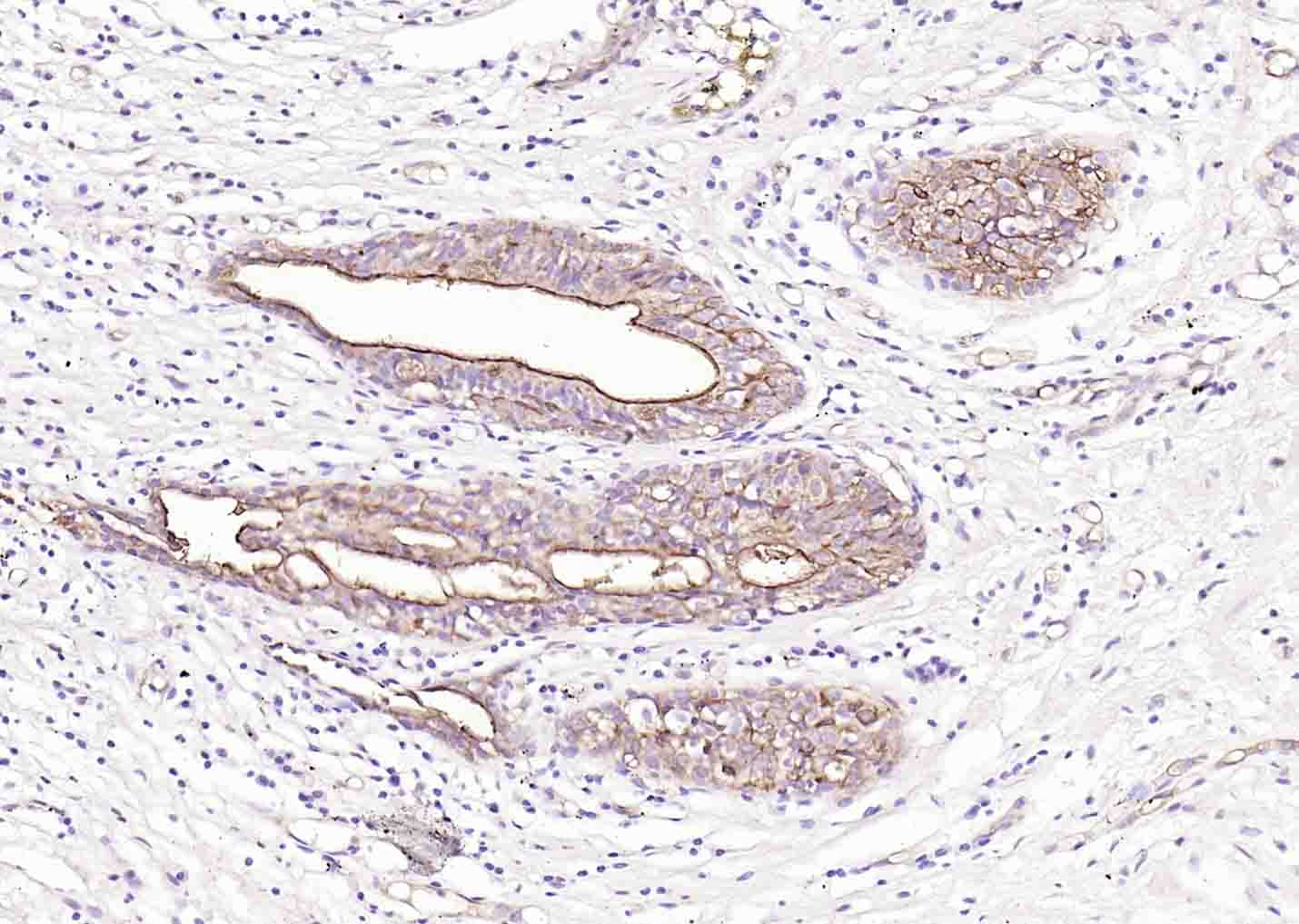
产品应用
| 应用 | 已检合格种属 | 预测种属 | 推荐稀释比例 |
|---|---|---|---|
| IHC-P | Human | 1:100-500 | |
| IHC-F | Human | 1:400-800 | |
| IF | Human | 1:100-500 |
交叉反应
交叉反应: Human
相关产品
暂无相关产品
同靶标产品
相关文献
提示: 发表研究结果有使用 bs-25588R 时请让我们知道,以便我们可以引用参考文章。作为回馈,资料提供者将获得我们送上的小礼品。