NQO1 Recombinant Rabbit mAb (一抗) - WB,Flow-Cyt | Bioss
Rrmab?兔单抗
货号:bsm-52830R
产品详情
相关标记
相关产品
相关文献
常见问题
概述
产品编号
bsm-52830R
产品类型
重组兔单抗
英文名称
NQO1 Recombinant Rabbit mAb
中文名称
醌氧化还原酶重组兔单抗
英文别名
DHQU; DIA4; DTD; NMOR1; NMORI; QR1; Nmo-1; Nmo1; Ox-1; Ox1; NADPH-d; NQO1_HUMAN; NQO1; Azoreductase; DT-diaphorase (DTD); Menadione reductase; NAD(P)H:quinone oxidoreductase 1; Phylloquinone reductase; Quinone reductase 1 (QR1); 1.6.5.2; NQO1_MOUSE; NQO1_RAT; NAD(P)H quinone dehydrogenase 1; diaphorase (NADH/NADPH) (cytochrome b-5 reductase); NAD(P)H dehydrogenase, quinone 1; DT-diaphorase; quinone reductase; NAD(P)H-quinone oxidoreductase
抗体来源
Rabbit
免疫原
A synthesized peptide derived from human NQO1: 1-46/274
亚型
IgG
性状
Liquid
纯化方法
affinity purified by Protein A
克隆类型
Recombinant
克隆号
8T5
理论分子量
31 kDa
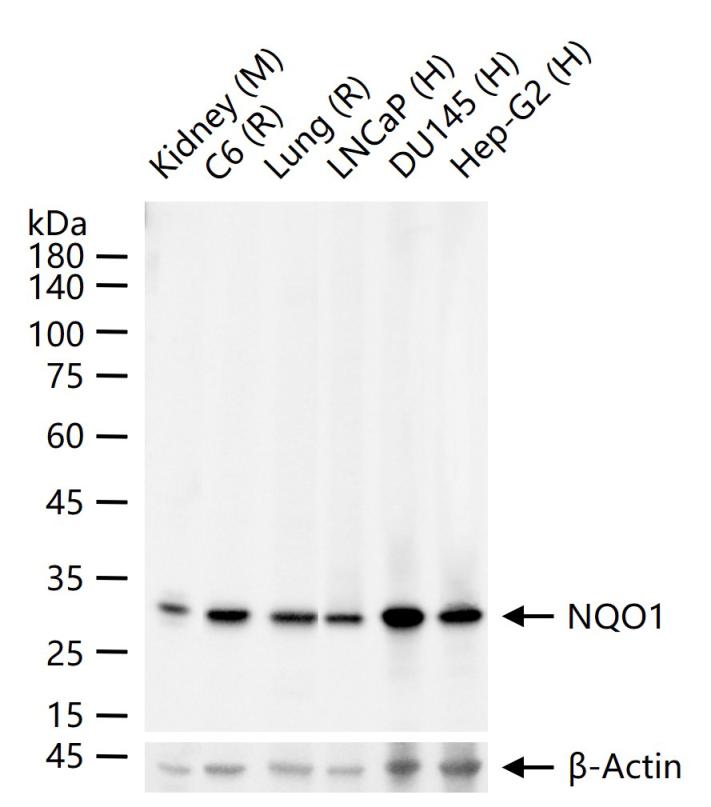
检测分子量
31 kDa
浓度
1mg/ml
储存液
0.01M TBS (pH7.4) with 1% BSA, 0.02% Proclin300 and 50% Glycerol.
研究领域
SWISS
Gene ID
保存条件
Shipped at 4℃. Store at -20℃ for one year. Avoid repeated freeze/thaw cycles.
注意事项
This product as supplied is intended for research use only, not for use in human, therapeutic or diagnostic applications.
数据库链接
产品介绍
合成与降解(Synthesis and Degradation)
醌氧化还原酶(NQO1)是一种黄素酶,它催化醌双电子还原反应,以减少氧自由基的产生。经研究发现NQO1可能有抗氧化效应,目前多用于帕金森病(PD)和部分肿瘤方面的研究。
醌是一种有毒的化合物,能诱发哺乳动物细胞癌变、突变和坏死。
醌氧化还原酶(NQO1)是一种黄素酶,它催化醌双电子还原反应,以减少氧自由基的产生。经研究发现NQO1可能有抗氧化效应,目前多用于帕金森病(PD)和部分肿瘤方面的研究。
醌是一种有毒的化合物,能诱发哺乳动物细胞癌变、突变和坏死。
背景资料
This gene is a member of the NAD(P)H dehydrogenase (quinone) family and encodes a cytoplasmic 2-electron reductase. This FAD-binding protein forms homodimers and reduces quinones to hydroquinones. This protein's enzymatic activity prevents the one electron reduction of quinones that results in the production of radical species. Mutations in this gene have been associated with tardive dyskinesia (TD), an increased risk of hematotoxicity after exposure to benzene, and susceptibility to various forms of cancer. Altered expression of this protein has been seen in many tumors and is also associated with Alzheimer's disease (AD). Alternate transcriptional splice variants, encoding different isoforms, have been characterized. [provided by RefSeq].
基因名
NQO1
蛋白名
NAD(P)H dehydrogenase [quinone] 1
亚基
Homodimer.
亚细胞定位
Cytoplasm.
相似性
Belongs to the NAD(P)H dehydrogenase (quinone) family.
功能
The enzyme apparently serves as a quinone reductase in connection with conjugation reactions of hydroquinons involved in detoxification pathways as well as in biosynthetic processes such as the vitamin K-dependent gamma-carboxylation of glutamate residues in prothrombin synthesis.
产品应用
| 应用 | 已检合格种属 | 预测种属 | 推荐稀释比例 |
|---|---|---|---|
| WB | Human, Mouse, Rat | 1:500-2000 | |
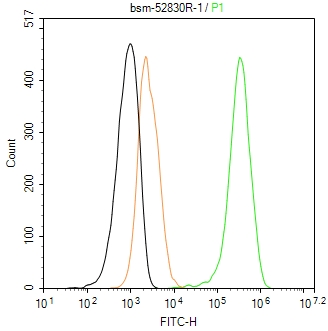
| Flow-Cyt | Human | Mouse, Rat | 1:50-100 |
交叉反应
交叉反应: Human, Mouse, Rat
相关产品
暂无相关产品
同靶标产品
相关文献
提示: 发表研究结果有使用 bsm-52830R 时请让我们知道,以便我们可以引用参考文章。作为回馈,资料提供者将获得我们送上的小礼品。
具体参考文献:bsm-52830R 被引用于4文献中