ASGR1 | ASGPR1 Rabbit pAb (一抗) - WB | Bioss
货号:bs-4119R
产品详情
相关标记
相关产品
相关文献
常见问题
概述
产品编号
bs-4119R
产品类型
农牧业/家禽抗体
英文名称
ASGR1 | ASGPR1 Rabbit pAb
中文名称
唾液酸糖蛋白受体1抗体
英文别名
ASGPR; ASGPR1; CLEC4H1; HL-1; Asgr; Asgr-1; RATRHL1; RHL1; ASGR1_HUMAN; ASGR1; ASGP-R 1; ASGPR 1; C-type lectin domain family 4 member H1; Hepatic lectin H1 (HL-1); ASGR1_MOUSE; Hepatic lectin 1 (HL-1 | mHL-1); ASGR1_RAT; Hepatic lectin 1 (HL-1 | rHL-1); asialoglycoprotein receptor 1
抗体来源
Rabbit
免疫原
KLH conjugated synthetic peptide derived from human ASGPR1: 201-291/291
亚型
IgG
性状
Liquid
纯化方法
affinity purified by Protein A
克隆类型
Polyclonal
理论分子量
32 kDa
检测分子量
47 kDa
浓度
1mg/ml
储存液
0.01M TBS (pH7.4) with 1% BSA, 0.02% Proclin300 and 50% Glycerol.
SWISS
Gene ID
保存条件
Shipped at 4℃. Store at -20℃ for one year. Avoid repeated freeze/thaw cycles.
注意事项
This product as supplied is intended for research use only, not for use in human, therapeutic or diagnostic applications.
数据库链接
背景资料
ASGR is a heterooligomeric receptor that is abundantly expressed on the sinusoidal surface of the hepatic plasma membrane. It is an endocytic receptor that rapidly binds and internalizes galactose-terminated glycoproteins (asialoglycoproteins or ASGP) from the circulation. The mouse ASGPR belongs to the long-form subfamily of the C-type/Ca2+ dependent lectin family. It is a complex of two noncovalently-linked and highly homologous subunits, a major 42 kDa glycoprotein ASGPR1(MHL-1) and a minor 51 kDa glycoprotein ASGR2 (MHL-2). ASGPR1 is synthesized as a type II transmembrane protein that contains a cytosolic N-terminal domain, a single transmembrane segment, and an extracellular domain which contains two important structural regions. The first is a stalk domain that contributes to noncovalent oligomerization, and the second is a Ca2+-dependent carbohydrate binding domain at the very C-terminus that is unusually stabilized by three ions. The aa sequence of mouse ASGPR1 ECD is 89% and 79% identical to the ASGPR1 ECD of rat and human, respectively.
基因名
ASGR1
蛋白名
Asialoglycoprotein receptor 1
亚基
Interacts with LASS2.
亚细胞定位
Membrane; Single-pass type II membrane protein.
组织特异性
Expressed exclusively in hepatic parenchymal cells.
翻译后修饰
Phosphorylated on a cytoplasmic Ser residue.
相似性
Contains 1 C-type lectin domain.
功能
Mediates the endocytosis of plasma glycoproteins to which the terminal sialic acid residue on their complex carbohydrate moieties has been removed. The receptor recognizes terminal galactose and N-acetylgalactosamine units. After ligand binding to the receptor, the resulting complex is internalized and transported to a sorting organelle, where receptor and ligand are disassociated. The receptor then returns to the cell membrane surface.
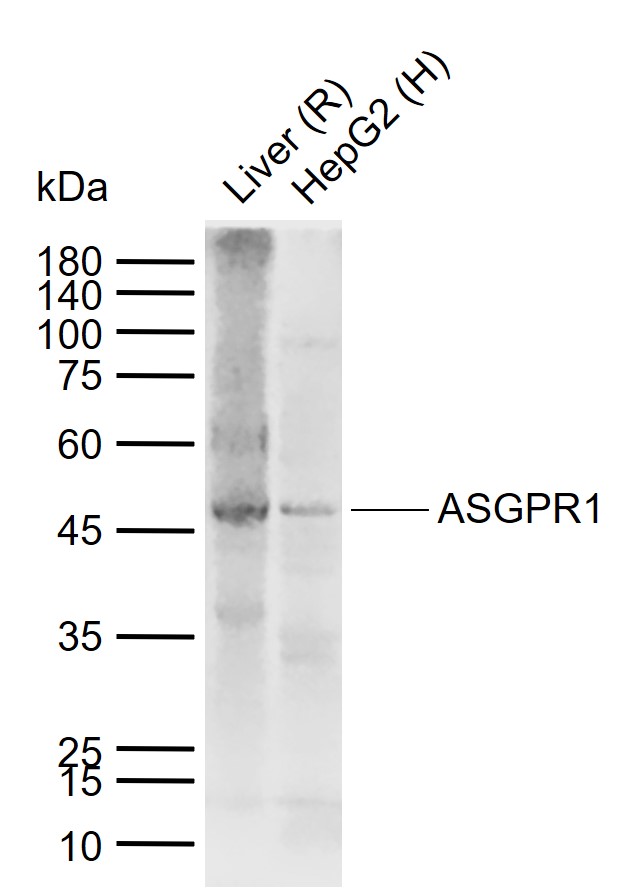
产品应用
| 应用 | 已检合格种属 | 预测种属 | 推荐稀释比例 |
|---|---|---|---|
| WB | Human, Rat | Mouse, Rabbit, Pig, Cow, Horse | 1:500-2000 |
交叉反应
交叉反应: Human, Rat (predicted: Mouse, Rabbit, Pig, Cow, Horse)
相关产品
暂无相关产品
同靶标产品
相关文献
提示: 发表研究结果有使用 bs-4119R 时请让我们知道,以便我们可以引用参考文章。作为回馈,资料提供者将获得我们送上的小礼品。
具体参考文献:bs-4119R 被引用于1文献中