phospho-TBK1 (Ser172) Recombinant Rabbit mAb (一抗) - WB | Bioss
Rrmab?兔单抗
货号:bsm-60659R
产品详情
相关标记
相关产品
相关文献
常见问题
概述
产品编号
bsm-60659R
产品类型
磷酸化抗体、重组兔单抗
英文名称
phospho-TBK1 (Ser172) Recombinant Rabbit mAb
中文名称
磷酸化NF-κB活化激酶重组兔单抗
英文别名
AIARV; FTDALS4; IIAE8; NAK; T2K; 1200008B05Rik; TBK1_HUMAN; TBK1; NF-kappa-B-activating kinase; TANK-binding kinase 1; 2.7.11.1; TBK1_MOUSE; TANK binding kinase 1; TBK1 (phospho-S172); p-TBK1; phospho-TBK1; TBK1 (phospho-Ser172)
抗体来源
Rabbit
免疫原
A synthesized peptide derived from human TBK1 around the phosphorylation site of S172: QFV-pS-LYG
亚型
IgG
性状
Liquid
纯化方法
affinity purified by Protein A
克隆类型
Recombinant
克隆号
R7D3
理论分子量
84 kDa
检测分子量
80 kDa
浓度
1mg/ml
储存液
0.01M TBS (pH7.4) with 1% BSA, 0.02% Proclin300 and 50% Glycerol.
研究领域
SWISS
Gene ID
保存条件
Shipped at 4℃. Store at -20℃ for one year. Avoid repeated freeze/thaw cycles.
注意事项
This product as supplied is intended for research use only, not for use in human, therapeutic or diagnostic applications.
数据库链接
产品介绍
TBK1是NF-κB信号通道中的一种激酶,它是被KRAS-改变的细胞存活所必不可少的。TBK1诱导反凋亡信号,TBK1与NF-κB共同作用于KRAS介导的癌变过程中,可能是一个癌症治疗目标。
背景资料
The NF-kappa-B (NFKB) complex of proteins is inhibited by I-kappa-B (IKB) proteins, which inactivate NFKB by trapping it in the cytoplasm. Phosphorylation of serine residues on the IKB proteins by IKB kinases marks them for destruction via the ubiquitination pathway, thereby allowing activation and nuclear translocation of the NFKB complex. The protein encoded by this gene is similar to IKB kinases and can mediate NFKB activation in response to certain growth factors. [provided by RefSeq, Oct 2010]
基因名
TBK1
蛋白名
Serine/threonine-protein kinase TBK1
亚基
Self-associates. Interacts with TIRAP, TANK and TRAF2. Part of a ternary complex consisting of TANK, TRAF2 and TBK1.
亚细胞定位
Nucleus.
组织特异性
Ubiquitous with higher expression in testis.
相似性
Belongs to the protein kinase superfamily. Ser/Thr protein kinase family. I-kappa-B kinase subfamily.
Contains 1 protein kinase domain.
Contains 1 ubiquitin-like domain.
Contains 1 protein kinase domain.
Contains 1 ubiquitin-like domain.
功能
Serine/threonine protein involved in the signaling cascade converging to the activation of the transcription factor NF-kappa-B. May function as an IKK kinase, playing an essential role in the transcription of a subset of TNF-alpha-induced genes. Also mediates production of RANTES/CCL5 and interferon-beta/IFNB1. Has a pivotal role in the innate immune response. Phosphorylates Borna disease virus (BDV) P protein. Phosphorylates and activates IRF3 and IRF7 and allows their nuclear localization. This leads to production of alpha/beta interferons and the development of a cellular antiviral state. It also seems to be a central factor in the induction of the antiviral interferon response. Inhibition of its interaction with IRF3, due to HCV NS3 binding or BDV P protein seems to be one mechanism of inhibition of the innate immune responses of hepatitis C virus (HCV) infection or Borna disease virus infection respectively.
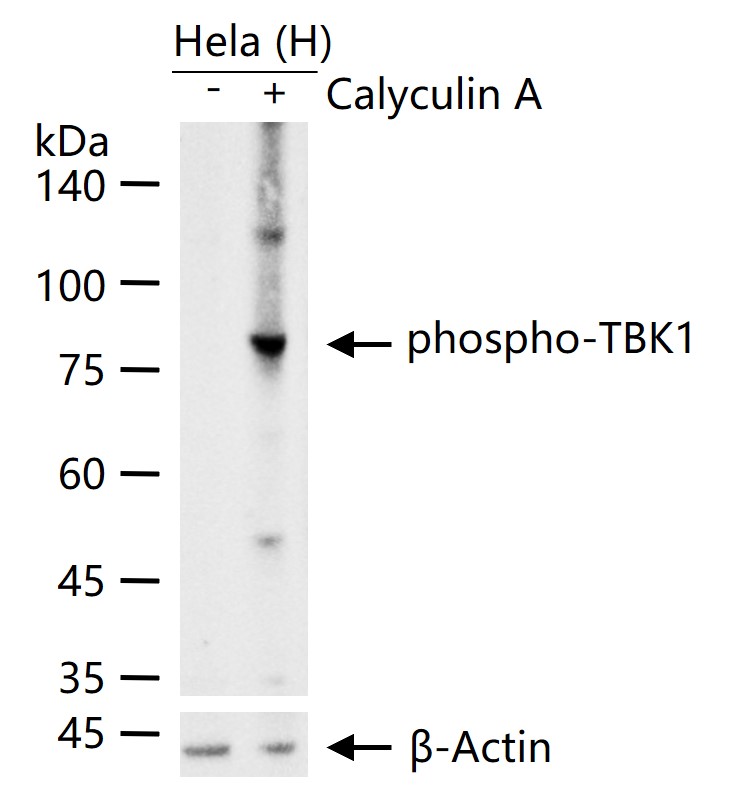
产品应用
| 应用 | 已检合格种属 | 预测种属 | 推荐稀释比例 |
|---|---|---|---|
| WB | Human | Mouse, Rat, Rabbit, Cow, Chicken, Dog, Horse | 1:500-2000 |
交叉反应
交叉反应: Human (predicted: Mouse, Rat, Rabbit, Cow, Chicken, Dog, Horse)
相关产品
暂无相关产品
同靶标产品
相关文献
提示: 发表研究结果有使用 bsm-60659R 时请让我们知道,以便我们可以引用参考文章。作为回馈,资料提供者将获得我们送上的小礼品。