GluR2 Recombinant Rabbit mAb (一抗) - WB,ICC/IF,IP | Bioss
Rrmab?兔单抗
货号:bsm-62211R
产品详情
相关标记
相关产品
相关文献
常见问题
概述
产品编号
bsm-62211R
产品类型
重组兔单抗
英文名称
GluR2 Recombinant Rabbit mAb
中文名称
谷氨酸受体2重组兔单抗
英文别名
GLUR2; GLURB; GluA2; GluR-K2; HBGR2; NEDLIB; gluR-2; gluR-B; GRIA2_HUMAN; GRIA2; AMPA-selective glutamate receptor 2; Glutamate receptor ionotropic, AMPA 2; GRIA2_MOUSE; GRIA2_RAT; glutamate ionotropic receptor AMPA type subunit 2; glutamate receptor, ionotropic, AMPA 2; Glutamate receptor 2; AMPA receptor subunit GluA2
抗体来源
Rabbit
免疫原
A synthesized peptide derived from human GluR2: 190-220
亚型
IgG
性状
Liquid
纯化方法
affinity purified by Protein A
克隆类型
Recombinant
克隆号
20B6
理论分子量
99 kDa
检测分子量
100 kDa
储存液
10mM phosphate buffered saline(pH 7.4) with 150mM sodium chloride, 0.05% BSA, 0.02% Proclin300 and 50% glycerol.
研究领域
SWISS
Gene ID
保存条件
Store at 4℃ for short term. Store at -20℃ for long term. Avoid repeated freeze/thaw cycles.
注意事项
This product as supplied is intended for research use only, not for use in human, therapeutic or diagnostic applications.
数据库链接
背景资料
GluR2 an integral membrane protein belonging to the glutamate-gated ion channel family. L-glutamate (Glu) acts as an excitatory neurotransmitter at many synapses in the central nervous system. Glutamate receptors are heteromeric protein complexes with multiple subunits, each possessing transmembrane regions, and all arranged to form a ligand-gated ion channel. The postsynaptic actions of Glu are mediated by a variety of receptors that are named according to their selective agonists.
基因名
GRIA2
蛋白名
Glutamate receptor 2
亚基
Homotetramer or heterotetramer of pore-forming glutamate receptor subunits. Tetramers may be formed by the dimerization of dimers. May interact with MPP4. Forms a ternary complex with GRIP1 and CSPG4. Interacts with ATAD1 in an ATP-dependent manner. ATAD1-catalyzed ATP hydrolysis disrupts binding to ATAD1 and to GRIP1 and leads to AMPAR complex disassembly. Interacts with PICK1 (via PDZ domain). Interacts with PRKCABP and GRIP2. Interacts with GRIA1 and SYNDIG1. Interacts with LRFN1. Found in a complex with GRIA1, GRIA3, GRIA4, CNIH2, CNIH3, CACNG2, CACNG3, CACNG4, CACNG5, CACNG7 and CACNG8. Interacts with CACNG5.
亚细胞定位
Cell membrane; Multi-pass membrane protein. Endoplasmic reticulum membrane; Multi-pass membrane protein. Cell junction, synapse, postsynaptic cell membrane; Multi-pass membrane protein.
翻译后修饰
Palmitoylated. Depalmitoylated upon glutamate stimulation. Cys-610 palmitoylation leads to Golgi retention and decreased cell surface expression. In contrast, Cys-836 palmitoylation does not affect cell surface expression but regulates stimulation-dependent endocytosis (By similarity).
相似性
Belongs to the glutamate-gated ion channel (TC 1.A.10.1) family. GRIA2 subfamily.
功能
Ionotropic glutamate receptor. L-glutamate acts as an excitatory neurotransmitter at many synapses in the central nervous system. Binding of the excitatory neurotransmitter L-glutamate induces a conformation change, leading to the opening of the cation channel, and thereby converts the chemical signal to an electrical impulse. The receptor then desensitizes rapidly and enters a transient inactive state, characterized by the presence of bound agonist. In the presence of CACNG4 or CACNG7 or CACNG8, shows resensitization which is characterized by a delayed accumulation of current flux upon continued application of glutamate.
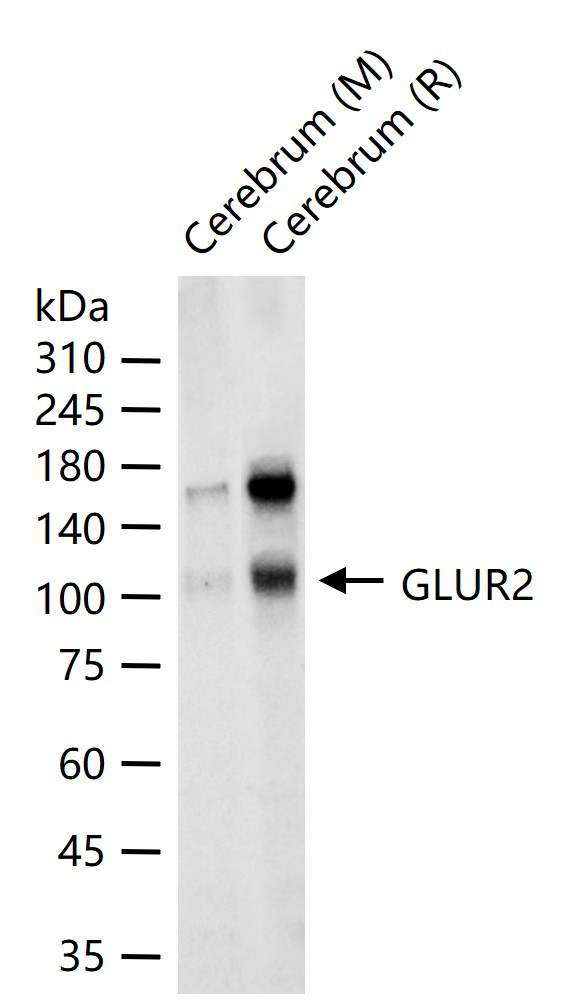
产品应用
| 应用 | 已检合格种属 | 预测种属 | 推荐稀释比例 |
|---|---|---|---|
| WB | Mouse, Rat | Human | 1:500-2000 |
| ICC/IF | Human, Mouse, Rat | 1:50-200 | |
| IP | Human, Mouse, Rat | 1:20-50 |
交叉反应
交叉反应: Mouse, Rat (predicted: Human)
相关产品
暂无相关产品
同靶标产品
相关文献
提示: 发表研究结果有使用 bsm-62211R 时请让我们知道,以便我们可以引用参考文章。作为回馈,资料提供者将获得我们送上的小礼品。