TRPM8 Recombinant Rabbit mAb (一抗) - WB | Bioss
Rrmab?兔单抗
货号:bsm-61651R
产品详情
相关标记
相关产品
相关文献
常见问题
概述
产品编号
bsm-61651R
产品类型
重组兔单抗、离子通道抗体
英文名称
TRPM8 Recombinant Rabbit mAb
中文名称
“冷”蛋白TRPM8重组兔单抗
英文别名
LTRPC6; LTrpC-6; TRPP8; trp-p8; CMR1; TRPM8_HUMAN; TRPM8; Long transient receptor potential channel 6 (LTrpC-6 | LTrpC6); Transient receptor potential p8 (Trp-p8); TRPM8_MOUSE; TRPM8_RAT; Cold menthol receptor 1; transient receptor potential cation channel subfamily M member 8; transient receptor potential cation channel, subfamily M, member 8
抗体来源
Rabbit
免疫原
A synthesized peptide derived from human TRPM8: 900-1000
亚型
IgG
性状
Liquid
纯化方法
affinity purified by Protein A
克隆类型
Recombinant
克隆号
4G6
理论分子量
128 kDa
检测分子量
105 kDa
储存液
10mM phosphate buffered saline(pH 7.4) with 150mM sodium chloride, 0.05% BSA, 0.02% Proclin300 and 50% glycerol.
研究领域
SWISS
Gene ID
保存条件
Store at 4℃ for short term. Store at -20℃ for long term. Avoid repeated freeze/thaw cycles.
注意事项
This product as supplied is intended for research use only, not for use in human, therapeutic or diagnostic applications.
数据库链接
产品介绍
TRPM8与感应热和辣的蛋白质属于同一家族,它存在于特定神经细胞的细胞膜上,成为响应外界信号的开关通道。科学家研究发现,当温度低于27摄氏度或者醇存在的条件下,TRPM8通道都会打开,使钙离子等带正电的粒子进入细胞。
TRPM8的蛋白质在产生冷知觉的过程中起着主导作用,并且控制着低温对机体疼痛的缓解效果,
TRPM8故称是“冷”蛋白。
背景资料
Receptor-activated non-selective cation channel involved in detection of sensations such as coolness, by being activated by cold temperature below 25 degrees Celsius. Activated by icilin, eucalyptol, menthol, cold and modulation of intracellular pH. Involved in menthol sensation. Permeable for monovalent cations sodium, potassium, and cesium and divalent cation calcium. Temperature sensing is tightly linked to voltage-dependent gating.
基因名
TRPM8
蛋白名
Transient receptor potential cation channel subfamily M member 8
亚基
Homotetramer (By similarity).
亚细胞定位
Membrane; Multi-pass membrane protein (Probable).
组织特异性
Expressed in prostate. Also expressed in most in prostate tumors. Also expressed in non-prostatic primary tumors such as colon, lung, breast and skin tumors.
相似性
Belongs to the transient receptor (TC 1.A.4) family. LTrpC subfamily. TRPM8 ub-subfamily.
功能
Receptor-activated non-selective cation channel involved in detection of sensations such as coolness, by being activated by cold temperature below 25 degrees Celsius. Activated by icilin, eucalyptol, menthol, cold and modulation of intracellular pH. Involved in menthol sensation. Permeable for monovalent cations sodium, potassium, and cesium and divalent cation calcium. Temperature sensing is tightly linked to voltage-dependent gating. Activated upon depolarization, changes in temperature resulting in graded shifts of its voltage-dependent activation curves. The chemical agonists menthol functions as a gating modifier, shifting activation curves towards physiological membrane potentials. Temperature sensitivity arises from a tenfold difference in the activation energies associated with voltage-dependent opening and closing.
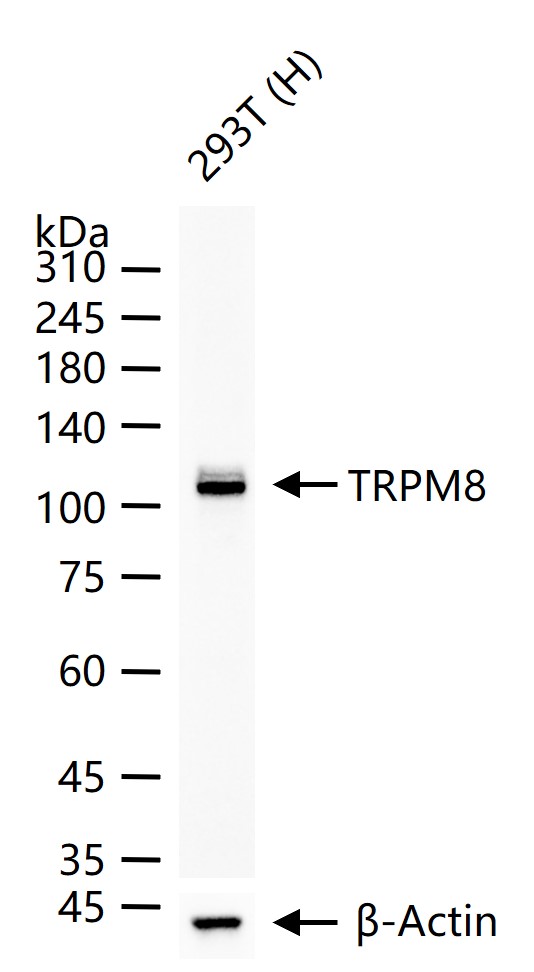
产品应用
| 应用 | 已检合格种属 | 预测种属 | 推荐稀释比例 |
|---|---|---|---|
| WB | Human | 1:500-2000 |
交叉反应
交叉反应: Human
相关产品
暂无相关产品
同靶标产品
相关文献
提示: 发表研究结果有使用 bsm-61651R 时请让我们知道,以便我们可以引用参考文章。作为回馈,资料提供者将获得我们送上的小礼品。