JUP | gamma Catenin Recombinant Rabbit mAb (一抗) - WB | Bioss
Rrmab?兔单抗
货号:bsm-61391R
产品详情
相关标记
相关产品
相关文献
常见问题
概述
产品编号
bsm-61391R
产品类型
重组兔单抗、宠物抗体
英文名称
JUP | gamma Catenin Recombinant Rabbit mAb
中文名称
γ-连环素/连接蛋白γ重组兔单抗
英文别名
CTNNG; DP3; DPIII; PDGB; PG; PKGB; D930025P04Rik; PLAK_HUMAN; JUP; Catenin gamma; Desmoplakin III; Desmoplakin-3; PLAK_MOUSE; PLAK_RAT; junction plakoglobin; catenin (cadherin-associated protein), gamma 80kDa; desmosomal protein 3
抗体来源
Rabbit
免疫原
A synthesized peptide derived from human gamma Catenin: 1-130/745
亚型
IgG
性状
Liquid
纯化方法
affinity purified by Protein A
克隆类型
Recombinant
克隆号
2C6
理论分子量
82 kDa
检测分子量
82 kDa
储存液
0.01M TBS (pH7.4) with 1% BSA, 0.02% Proclin300 and 50% Glycerol.
研究领域
SWISS
Gene ID
保存条件
Shipped at 4℃. Store at -20℃ for one year. Avoid repeated freeze/thaw cycles.
注意事项
This product as supplied is intended for research use only, not for use in human, therapeutic or diagnostic applications.
数据库链接
产品介绍
细胞骨架的微丝E-cad通过相关蛋白α、β、γ-cat经羟基端在细胞内与细胞骨架的微丝连接形成E-cad/cat)复合体,参与细胞粘附、生长、增殖等过程.
背景资料
Common junctional plaque protein. The membrane-associated plaques are architectural elements in an important strategic position to influence the arrangement and function of both the cytoskeleton and the cells within the tissue.
基因名
JUP
蛋白名
Junction plakoglobin
亚基
Cell junction, adherens junction. Cell junction, desmosome. Cytoplasm, cytoskeleton. Membrane; Peripheral membrane protein. Note=Cytoplasmic in a soluble and membrane-associated form.
亚细胞定位
Cell junction, adherens junction. Cell junction, desmosome. Cytoplasm, cytoskeleton. Membrane. Cytoplasmic in a soluble and membrane-associated form.
翻译后修饰
May be phosphorylated by FER.
疾病
Defects in JUP are the cause of Naxos disease (NXD) [MIM:601214]. NXD is an autosomal recessive disorder combining diffuse non-epidermolytic palmoplantar keratoderma with arrhythmogenic right ventricular dysplasia/cardiomyopathy and woolly hair.
Defects in JUP are the cause of familial arrhythmogenic right ventricular dysplasia type 12 (ARVD12) [MIM:611528]; also called arrhythmogenic right ventricular cardiomyopathy 12 (ARVC12). ARVD is an autosomal dominant disease characterized by partial degeneration of the myocardium of the right ventricle, electrical instability, and sudden death. It is clinically defined by electrocardiographic and angiographic criteria; pathologic findings, replacement of ventricular myocardium with fatty and fibrous elements, preferentially involve the right ventricular free wall.
Defects in JUP are the cause of familial arrhythmogenic right ventricular dysplasia type 12 (ARVD12) [MIM:611528]; also called arrhythmogenic right ventricular cardiomyopathy 12 (ARVC12). ARVD is an autosomal dominant disease characterized by partial degeneration of the myocardium of the right ventricle, electrical instability, and sudden death. It is clinically defined by electrocardiographic and angiographic criteria; pathologic findings, replacement of ventricular myocardium with fatty and fibrous elements, preferentially involve the right ventricular free wall.
相似性
Belongs to the beta-catenin family.
Contains 9 ARM repeats.
Contains 9 ARM repeats.
功能
Common junctional plaque protein. The membrane-associated plaques are architectural elements in an important strategic position to influence the arrangement and function of both the cytoskeleton and the cells within the tissue. The presence of plakoglobin in both the desmosomes and in the intermediate junctions suggests that it plays a central role in the structure and function of submembranous plaques. Acts as a substrate for VE-PTP and is required by it to stimulate VE-cadherin function in endothelial cells. Can replace beta-catenin in E-cadherin/catenin adhesion complexes which are proposed to couple cadherins to the actin cytoskeleton.
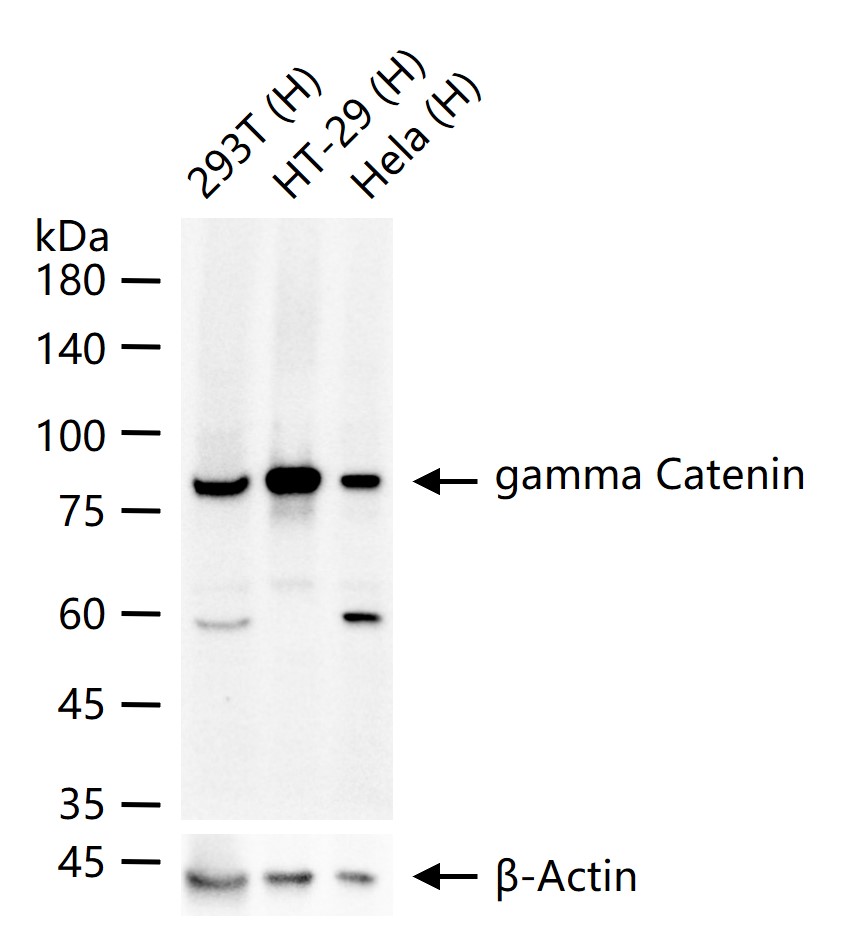
产品应用
| 应用 | 已检合格种属 | 预测种属 | 推荐稀释比例 |
|---|---|---|---|
| WB | Human | Mouse, Rat | 1:500-2000 |
交叉反应
交叉反应: Human (predicted: Mouse, Rat)
相关产品
暂无相关产品
同靶标产品
相关文献
提示: 发表研究结果有使用 bsm-61391R 时请让我们知道,以便我们可以引用参考文章。作为回馈,资料提供者将获得我们送上的小礼品。