FANCD2 | FACD2 Recombinant Rabbit mAb (一抗) | Bioss
Rrmab?兔单抗
货号:bsm-61302R
产品详情
相关标记
相关产品
相关文献
常见问题
概述
产品编号
bsm-61302R
产品类型
重组兔单抗
英文名称
FANCD2 | FACD2 Recombinant Rabbit mAb
中文名称
FANCD2重组兔单抗
英文别名
FA-D2; FA4; FACD; FAD; FAD2; FANCD; 2410150O07Rik; FACD2_HUMAN; FANCD2; Protein FACD2; FACD2_MOUSE; FACD2_RAT; FA complementation group D2; Fanconi anemia complementation group D2
抗体来源
Rabbit
免疫原
A synthesized peptide derived from human FANCD2: 200-255/1451
亚型
IgG
性状
Liquid
纯化方法
affinity purified by Protein A
克隆类型
Recombinant
克隆号
17C6
理论分子量
164 kDa
检测分子量
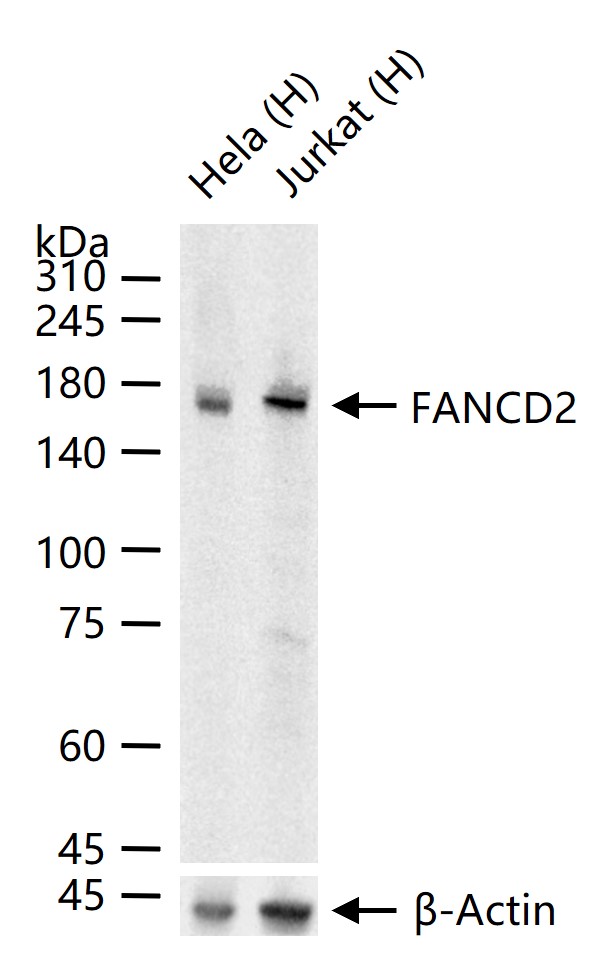
170 kDa
储存液
0.01M TBS (pH7.4) with 1% BSA, 0.02% Proclin300 and 50% Glycerol.
SWISS
Gene ID
保存条件
Shipped at 4℃. Store at -20℃ for one year. Avoid repeated freeze/thaw cycles.
注意事项
This product as supplied is intended for research use only, not for use in human, therapeutic or diagnostic applications.
数据库链接
产品介绍
FANCD2是一种在DNA损伤修复过程中起重要作用的蛋白质,其作作用在于通过修补DNA损伤或促进有缺陷细胞自杀来预防癌症,所以低水平的FANCD2会导致DNA损伤,从而诱发癌症。
有学者认为:FANCD2是个重要的抵御癌症蛋白,而香烟会破坏它的制造过程当然还可能包含有其他蛋白,但至少FANCD2是关键的主要蛋白,因为含有非常高水平FANCD2的细胞能够抵御香烟的毒害作用。
FANCD2蛋白在保护肺细胞抵御香烟威胁时有重要作用;FANCD2蛋白是负责修复受损DNA的重要蛋白,而受香烟燃烧产生的烟雾影响的肺细胞很少产生FANCD2蛋白,没有FANCD2蛋白,受损的DNA导致肿瘤细胞增殖扩散并无法控制。研究结果表明,FANCD2蛋白在保护肺细胞抵御香烟威胁时有重要作用,也可解释为什麽香烟燃烧产生的烟雾对肺细胞具有如此大的危害。
有学者认为:FANCD2是个重要的抵御癌症蛋白,而香烟会破坏它的制造过程当然还可能包含有其他蛋白,但至少FANCD2是关键的主要蛋白,因为含有非常高水平FANCD2的细胞能够抵御香烟的毒害作用。
FANCD2蛋白在保护肺细胞抵御香烟威胁时有重要作用;FANCD2蛋白是负责修复受损DNA的重要蛋白,而受香烟燃烧产生的烟雾影响的肺细胞很少产生FANCD2蛋白,没有FANCD2蛋白,受损的DNA导致肿瘤细胞增殖扩散并无法控制。研究结果表明,FANCD2蛋白在保护肺细胞抵御香烟威胁时有重要作用,也可解释为什麽香烟燃烧产生的烟雾对肺细胞具有如此大的危害。
背景资料
Required for maintenance of chromosomal stability. Promotes accurate and efficient pairing of homologs during meiosis. Involved in the repair of DNA double-strand breaks, both by homologous recombination and single-strand annealing. May participate in S phase and G2 phase checkpoint activation upon DNA damage. Plays a role in preventing breakage and loss of missegregating chromatin at the end of cell division, particularly after replication stress.
基因名
FANCD2
蛋白名
Fanconi anemia group D2 protein
亚基
Interacts directly with FANCE and FANCI. Interacts with USP1 and MEN1. The ubiquitinated form specifically interacts with BRCA1 and BLM. Both the nonubiquitinated and the monoubiquitinated forms interact with BRCA2; this interaction is mediated by phosphorylated FANCG and the complex also includes XCCR3. The ubiquitinated form specifically interacts with MTMR15/FAN1 (via UBZ-type zinc finger), leading to recruit MTMR15/FAN1 to sites of DNA damage. Interacts with DCLRE1B/Apollo.
亚细胞定位
Nucleus. Note=Concentrates in nuclear foci during S phase and upon genotoxic stress. At the onset of mitosis, excluded from chromosomes and diffuses into the cytoplasm, returning to the nucleus at the end of cell division. Observed in a few spots localized in pairs on the sister chromatids of mitotic chromosome arms and not centromeres, one on each chromatids. These foci coincide with common fragile sites and could be sites of replication fork stalling. The foci are frequently interlinked through BLM-associated ultra-fine DNA bridges. Following aphidicolin treatment, targets chromatid gaps and breaks.
组织特异性
Highly expressed in germinal center cells of the spleen, tonsil, and reactive lymph nodes, and in the proliferating basal layer of squamous epithelium of tonsil, esophagus, oropharynx, larynx and cervix. Expressed in cytotrophoblastic cells of the placenta and exocrine cells of the pancreas (at protein level). Highly expressed in testis, where expression is restricted to maturing spermatocytes.
翻译后修饰
Monoubiquitinated on Lys-561 during S phase and upon genotoxic stress by FANCL in complex with E2 ligases UBE2T or UBE2W (isoform 1 and isoform 2). Deubiquitinated by USP1 as cells enter G2/M, or once DNA repair is completed. Monoubiquitination requires the joint intervention of the FANC core complex, including FANCA, FANCB, FANCC, FANCE, FANCF, FANCG, and FANCM, and proteins involved in cell cycle checkpoints and DNA repair, including RPA1, ATR, CHEK1 and BRCA1, and is mediated by FANCL/PHF9. Ubiquitination is required for binding to chromatin, interaction with BRCA1, BRCA2 and MTMR15/FAN1, DNA repair, and normal cell cycle progression, but not for phosphorylation on Ser-222 or interaction with MEN1.
Phosphorylated in response to various genotoxic stresses by ATM and/or ATR. Upon ionizing radiation, phosphorylated by ATM on Ser-222 and Ser-1404. Phosphorylation on Ser-222 is required for S-phase checkpoint activation, but not for ubiquitination, foci formation, or DNA repair. In contrast, phosphorylation by ATR on other sites may be required for ubiquitination and foci formation.
Defects in FANCD2 are a cause of Fanconi anemia complementation group D type 2 (FANCD2) [MIM:227646]. A disorder affecting all bone marrow elements and resulting in anemia, leukopenia and thrombopenia. It is associated with cardiac, renal and limb malformations, dermal pigmentary changes, and a predisposition to the development of malignancies. At the cellular level it is associated with hypersensitivity to DNA-damaging agents, chromosomal instability (increased chromosome breakage) and defective DNA repair.
Phosphorylated in response to various genotoxic stresses by ATM and/or ATR. Upon ionizing radiation, phosphorylated by ATM on Ser-222 and Ser-1404. Phosphorylation on Ser-222 is required for S-phase checkpoint activation, but not for ubiquitination, foci formation, or DNA repair. In contrast, phosphorylation by ATR on other sites may be required for ubiquitination and foci formation.
Defects in FANCD2 are a cause of Fanconi anemia complementation group D type 2 (FANCD2) [MIM:227646]. A disorder affecting all bone marrow elements and resulting in anemia, leukopenia and thrombopenia. It is associated with cardiac, renal and limb malformations, dermal pigmentary changes, and a predisposition to the development of malignancies. At the cellular level it is associated with hypersensitivity to DNA-damaging agents, chromosomal instability (increased chromosome breakage) and defective DNA repair.
功能
Required for maintenance of chromosomal stability. Promotes accurate and efficient pairing of homologs during meiosis. Involved in the repair of DNA double-strand breaks, both by homologous recombination and single-strand annealing. May participate in S phase and G2 phase checkpoint activation upon DNA damage. Plays a role in preventing breakage and loss of missegregating chromatin at the end of cell division, particularly after replication stress. Required for the targeting, or stabilization, of BLM to non-centromeric abnormal structures induced by replicative stress. Promotes BRCA2/FANCD1 loading onto damaged chromatin. May also be involved in B-cell immunoglobulin isotype switching.
产品应用
| 应用 | 已检合格种属 | 预测种属 | 推荐稀释比例 |
|---|---|---|---|
| WB | Human | 1:500-2000 | |
| ICC/IF | Human | 1:50-200 | |
| IP | Human | 1:20-50 |
交叉反应
交叉反应: Human
相关产品
暂无相关产品
同靶标产品
相关文献
提示: 发表研究结果有使用 bsm-61302R 时请让我们知道,以便我们可以引用参考文章。作为回馈,资料提供者将获得我们送上的小礼品。