NLRP3 | NALP3/Cryopyrin Recombinant Rabbit mAb (一抗) - WB | Bioss
Rrmab?兔单抗
货号:bsm-61254R
产品详情
相关标记
相关产品
相关文献
常见问题
概述
产品编号
bsm-61254R
产品类型
重组兔单抗
英文名称
NLRP3 | NALP3/Cryopyrin Recombinant Rabbit mAb
中文名称
细胞凋亡诱导蛋白NALP3重组兔单抗
英文别名
AGTAVPRL; AII; AVP; C1orf7; CIAS1; CLR1.1; DFNA34; FCAS; FCAS1; FCU; KEFH; MWS; NALP3; PYPAF1; AII/AVP; Mmig1; NLRP3_HUMAN; NLRP3; Angiotensin/vasopressin receptor AII/AVP-like; Caterpiller protein 1.1 (CLR1.1); Cold-induced autoinflammatory syndrome 1 protein; Cryopyrin; PYRIN-containing APAF1-like protein 1; 3.6.4.-; NLRP3_MOUSE; Cold autoinflammatory syndrome 1 protein homolog; Mast cell maturation-associated-inducible protein 1; NLR family pyrin domain containing 3; cold autoinflammatory syndrome 1; deafness, autosomal dominant 34; nucleotide-binding oligomerization domain, leucine rich repeat and pyrin domain containing 3
抗体来源
Rabbit
免疫原
A synthesized peptide derived from human NLRP3: 1-150/1036
亚型
IgG
性状
Liquid
纯化方法
affinity purified by Protein A
克隆类型
Recombinant
克隆号
1F5
理论分子量
118 kDa
检测分子量
120 kDa
储存液
0.01M TBS (pH7.4) with 1% BSA, 0.02% Proclin300 and 50% Glycerol.
研究领域
SWISS
Gene ID
保存条件
Shipped at 4℃. Store at -20℃ for one year. Avoid repeated freeze/thaw cycles.
注意事项
This product as supplied is intended for research use only, not for use in human, therapeutic or diagnostic applications.
数据库链接
背景资料
Sensor component of the NLRP3 inflammasome, which mediates inflammasome activation in response to defects in membrane integrity, leading to secretion of inflammatory cytokines IL1B and IL18 and pyroptosis.
基因名
NLRP3
蛋白名
NACHT, LRR and PYD domains-containing protein 3
亚细胞定位
Cytoplasm.
组织特异性
Expressed in blood leukocytes. Strongly expressed in polymorphonuclear cells and osteoblasts. Undetectable or expressed at a lower magnitude in B- and T-lymphoblasts, respectively. High level of expression detected in chondrocytes. Detected in non-keratinizing epithelia of oropharynx, esophagus and ectocervix and in the urothelial layer of the bladder.
疾病
Defects in NLRP3 are the cause of familial cold autoinflammatory syndrome type 1 (FCAS1) [MIM:120100]; also known as familial cold urticaria. FCAS are rare autosomal dominant systemic inflammatory diseases characterized by episodes of rash, arthralgia, fever and conjunctivitis after generalized exposure to cold.
Defects in NLRP3 are a cause of Muckle-Wells syndrome (MWS) [MIM:191900]; also known as urticaria-deafness-amyloidosis syndrome. MWS is a hereditary periodic fever syndrome characterized by fever, chronic recurrent urticaria, arthralgias, progressive sensorineural deafness, and reactive renal amyloidosis. The disease may be severe if generalized amyloidosis occurs.
Defects in NLRP3 are the cause of chronic infantile neurologic cutaneous and articular syndrome (CINCA) [MIM:607115]; also known as neonatal onset multisystem inflammatory disease (NOMID). CINCA is a rare congenital inflammatory disorder characterized by a triad of neonatal onset of cutaneous symptoms, chronic meningitis and joint manifestations with recurrent fever and inflammation.
Defects in NLRP3 are a cause of Muckle-Wells syndrome (MWS) [MIM:191900]; also known as urticaria-deafness-amyloidosis syndrome. MWS is a hereditary periodic fever syndrome characterized by fever, chronic recurrent urticaria, arthralgias, progressive sensorineural deafness, and reactive renal amyloidosis. The disease may be severe if generalized amyloidosis occurs.
Defects in NLRP3 are the cause of chronic infantile neurologic cutaneous and articular syndrome (CINCA) [MIM:607115]; also known as neonatal onset multisystem inflammatory disease (NOMID). CINCA is a rare congenital inflammatory disorder characterized by a triad of neonatal onset of cutaneous symptoms, chronic meningitis and joint manifestations with recurrent fever and inflammation.
相似性
Belongs to the NLRP family.
Contains 1 DAPIN domain.
Contains 9 LRR (leucine-rich) repeats.
Contains 1 NACHT domain.
Contains 1 DAPIN domain.
Contains 9 LRR (leucine-rich) repeats.
Contains 1 NACHT domain.
功能
May function as an inducer of apoptosis. Interacts selectively with ASC and this complex may function as an upstream activator of NF-kappa-B signaling. Inhibits TNF-alpha induced activation and nuclear translocation of RELA/NF-KB p65. Also inhibits transcriptional activity of RELA. Activates caspase-1 in response to a number of triggers including bacterial or viral infection which leads to processing and release of IL1B and IL18.
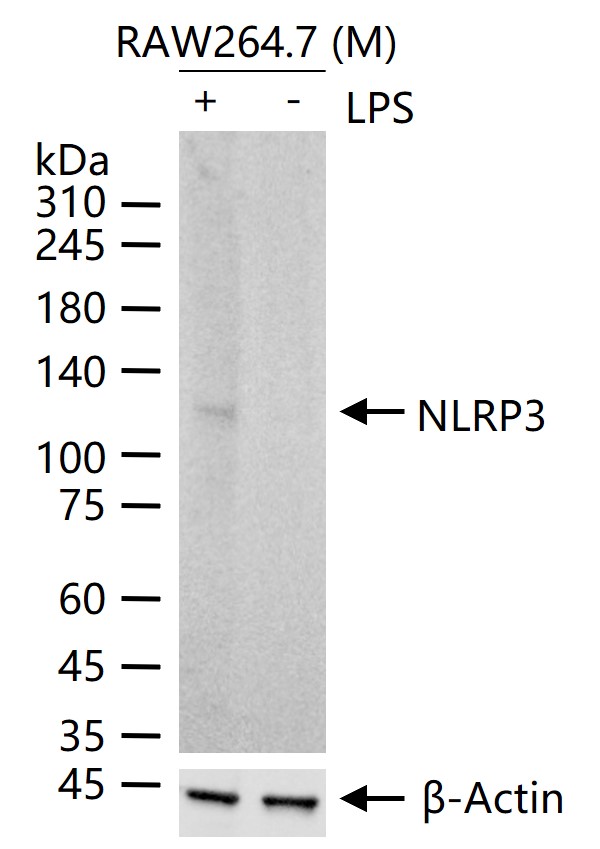
产品应用
| 应用 | 已检合格种属 | 预测种属 | 推荐稀释比例 |
|---|---|---|---|
| WB | Mouse | Human, Rat | 1:500-2000 |
交叉反应
交叉反应: Mouse (predicted: Human, Rat)
相关产品
暂无相关产品
同靶标产品
相关文献
提示: 发表研究结果有使用 bsm-61254R 时请让我们知道,以便我们可以引用参考文章。作为回馈,资料提供者将获得我们送上的小礼品。
具体参考文献:bsm-61254R 被引用于7文献中