LGR5/GPR49 Recombinant Rabbit mAb (一抗) - WB,Flow-Cyt | Bioss
Rrmab?兔单抗
货号:bsm-61052R
产品详情
相关标记
相关产品
相关文献
常见问题
概述
产品编号
bsm-61052R
产品类型
重组兔单抗
英文名称
LGR5/GPR49 Recombinant Rabbit mAb
中文名称
蛋白偶联受体49重组兔单抗
英文别名
FEX; GPR49; GPR67; GRP49; HG38; LGR5_HUMAN; LGR5; G-protein coupled receptor 49; G-protein coupled receptor 67; G-protein coupled receptor HG38; LGR5_MOUSE; Orphan G-protein coupled receptor FEX; leucine rich repeat containing G protein-coupled receptor 5; G protein-coupled receptor 49
抗体来源
Rabbit
免疫原
A synthesized peptide derived from human LGR5: 818-907
亚型
IgG
性状
Liquid
纯化方法
affinity purified by Protein A
克隆类型
Recombinant
克隆号
8H13
理论分子量
98 kDa
检测分子量
100 kDa
储存液
0.01M TBS(pH7.4) with 1% BSA, 0.02% Proclin300 and 50% Glycerol.
研究领域
SWISS
Gene ID
保存条件
Shipped at 4℃. Store at -20 °C for one year. Avoid repeated freeze/thaw cycles.
注意事项
This product as supplied is intended for research use only, not for use in human, therapeutic or diagnostic applications.
数据库链接
产品介绍
Lgr5基因(Wnt细胞信号系统)是一种G蛋白偶联受体,已经被确定为几种成年组织和癌症中干细胞的一个独特标记。Lgr5最初是在结肠癌细胞中发现的,有报道称:在恶化前的小鼠腺瘤中也有发现,这说明Lgr5很可能也是其他组织成体干细胞和癌症干细胞的标志物。
背景资料
The protein encoded by this gene is a leucine-rich repeat-containing receptor (LGR) and member of the G protein-coupled, 7-transmembrane receptor (GPCR) superfamily. The encoded protein is a receptor for R-spondins and is involved in the canonical Wnt signaling pathway. This protein plays a role in the formation and maintenance of adult intestinal stem cells during postembryonic development. Several transcript variants encoding different isoforms have been found for this gene. [provided by RefSeq, Sep 2015]
基因名
LGR5
蛋白名
Leucine-rich repeat-containing G-protein coupled receptor 5
亚基
Identified in a complex composed of RNF43, LGR5 and RSPO1.
亚细胞定位
Cell membrane; Multi-pass membrane protein.
组织特异性
Expressed in skeletal muscle, placenta, spinal cord, and various region of brain. Expressed at the base of crypts in colonic and small mucosa stem cells. In premalignant cancer expression is not restricted to the cript base. Overexpressed in cancers of the ovary, colon and liver.
相似性
Belongs to the G-protein coupled receptor 1 family.
Contains 16 LRR (leucine-rich) repeats.
Contains 1 LRRNT domain.
Contains 16 LRR (leucine-rich) repeats.
Contains 1 LRRNT domain.
功能
Receptor for R-spondins that potentiates the canonical Wnt signaling pathway and acts as a stem cell marker of the intestinal epithelium and the hair follicle. Upon binding to R-spondins (RSPO1, RSPO2, RSPO3 or RSPO4), associates with phosphorylated LRP6 and frizzled receptors that are activated by extracellular Wnt receptors, triggering the canonical Wnt signaling pathway to increase expression of target genes. In contrast to classical G-protein coupled receptors, does not activate heterotrimeric G-proteins to transduce the signal. Involved in the development and/or maintenance of the adult intestinal stem cells during postembryonic development.
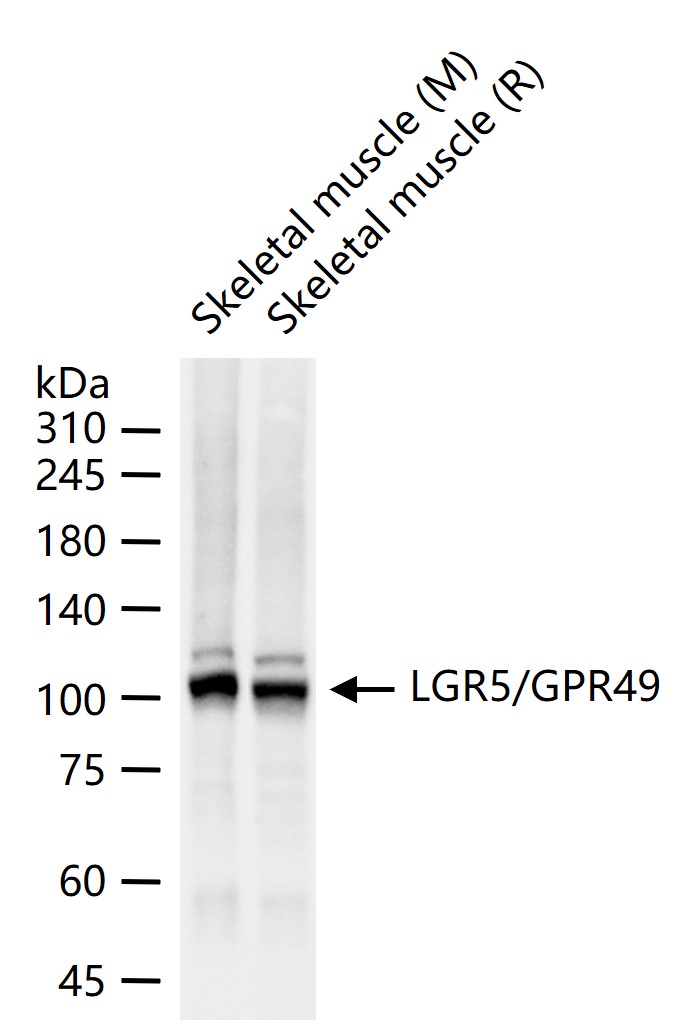
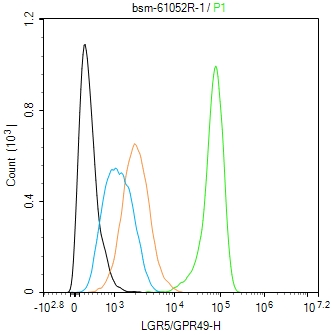
产品应用
| 应用 | 已检合格种属 | 预测种属 | 推荐稀释比例 |
|---|---|---|---|
| WB | Mouse, Rat | Human | 1:500-2000 |
| Flow-Cyt | Human | Mouse, Rat | 1:50-100 |
交叉反应
交叉反应: Human, Mouse, Rat
相关产品
暂无相关产品
同靶标产品
相关文献
提示: 发表研究结果有使用 bsm-61052R 时请让我们知道,以便我们可以引用参考文章。作为回馈,资料提供者将获得我们送上的小礼品。