Arginase 1 Recombinant Rabbit mAb (一抗) - WB | Bioss
Rrmab?兔单抗
货号:bsm-56207R
产品详情
相关标记
相关产品
相关文献
常见问题
概述
产品编号
bsm-56207R
产品类型
重组兔单抗
英文名称
Arginase 1 Recombinant Rabbit mAb
中文名称
精氨酸酶1重组兔单抗
英文别名
AI; Arg-1; PGIF; ARGI1_BOVIN; ARG1; Liver-type arginase; Type I arginase; 3.5.3.1; ARGI1_HUMAN; ARGI1_MOUSE; ARGI1_PIG; ARGI1_RABIT; ARGI1_RAT; arginase 1; arginase, liver; arginase-1
抗体来源
Rabbit
免疫原
A synthesized peptide derived from human Arginase 1: 11-71
亚型
IgG
性状
Liquid
纯化方法
affinity purified by Protein A
克隆类型
Recombinant
克隆号
19G6
理论分子量
35 kDa
检测分子量
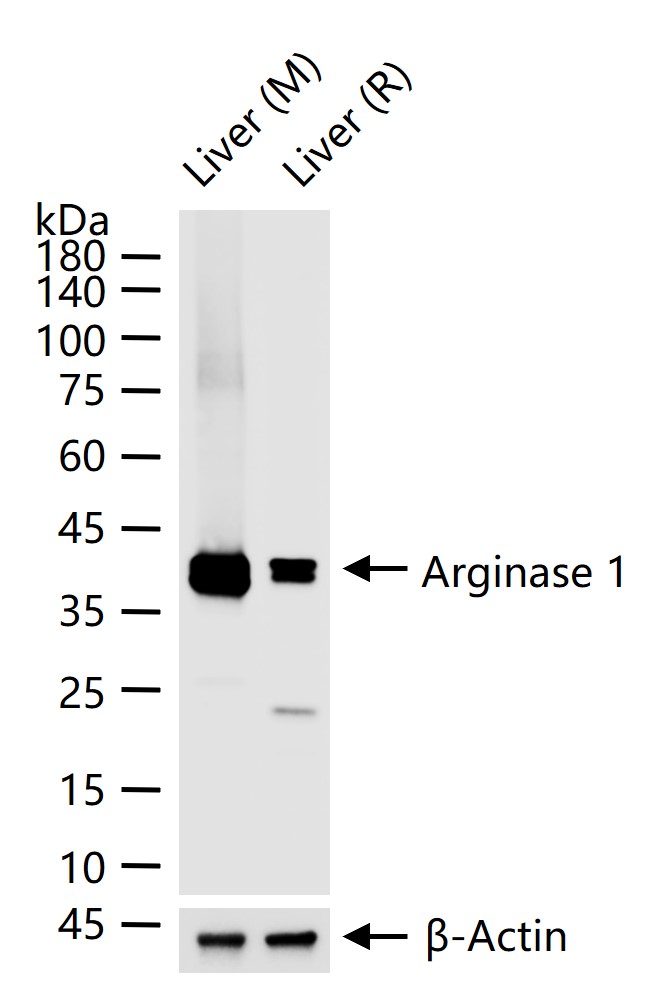
35-40 kDa
浓度
1mg/ml
储存液
59% PBS, 40% Glycerol , 0.05% BSA(pH7.2), Preservative: 0.02% Proclin300.
研究领域
SWISS
Gene ID
保存条件
Shipped at 4℃. Store at -20℃ for one year. Avoid repeated freeze/thaw cycles.
注意事项
This product as supplied is intended for research use only, not for use in human, therapeutic or diagnostic applications.
背景资料
Arginase I which is expressed almost exclusively in the liver, catalyzes the conversion of arginine to ornithine and urea . The human arginase I gene, which maps to chromosome 6q23, encodes a 322 amino acid protein. Arginase I exists as a homotrimeric protein and contains a binuclear manganese cluster. Arginase II catalyzes the same reaction as arginase I, but differs in its tissue specificity and subcellular location. Specifically, arginase II localizes to the mitochondria. Arginase II is expressed in non-hepatic tissues, with the highest levels of expression in the kidneys, but, unlike arginase I, is not expressed in liver. The human arginase II gene, which maps to chromosome 14q24.1-q24.3, encodes a 354 amino acid protein. In addition, arginase II contains a putative amino-terminal mitochondrial localization sequence.
基因名
ARG1
蛋白名
Arginase-1
亚基
Homotrimer.
亚细胞定位
Cytoplasm.
疾病
Defects in ARG1 are the cause of argininemia (ARGIN) ; also known as hyperargininemia. Argininemia is a rare autosomal recessive disorder of the urea cycle. Arginine is elevated in the blood and cerebrospinal fluid, and periodic hyperammonemia occurs. Clinical manifestations include developmental delay, seizures, mental retardation, hypotonia, ataxia, progressive spastic quadriplegia.
相似性
Belongs to the arginase family.
产品应用
| 应用 | 已检合格种属 | 预测种属 | 推荐稀释比例 |
|---|---|---|---|
| WB | Mouse, Rat | Human | 1:1000-5000 |
交叉反应
交叉反应: Mouse, Rat (predicted: Human)
相关产品
暂无相关产品
同靶标产品
相关文献
提示: 发表研究结果有使用 bsm-56207R 时请让我们知道,以便我们可以引用参考文章。作为回馈,资料提供者将获得我们送上的小礼品。
具体参考文献:bsm-56207R 被引用于1文献中