AT2R2 Rabbit pAb (一抗) | Bioss
货号:bs-2133R
产品详情
相关标记
相关产品
相关文献
常见问题
概述
产品编号
bs-2133R
产品类型
宠物抗体、农牧业/家禽抗体
英文名称
AT2R2 Rabbit pAb
中文名称
血管紧张素Ⅱ受体2抗体
英文别名
AGTR2_HUMAN; AGTR2; Angiotensin II type-2 receptor (AT2 receptor); AGTR2_MOUSE; Q3US12_MOUSE; Angiotensin II type-2 receptor; AGTR2_RAT;
抗体来源
Rabbit
免疫原
KLH conjugated synthetic peptide derived from human angiotensin II receptor type 2: 151-250/363 <Extracellular>
亚型
IgG
性状
Liquid
纯化方法
affinity purified by Protein A
克隆类型
Polyclonal
理论分子量
41 kDa
检测分子量
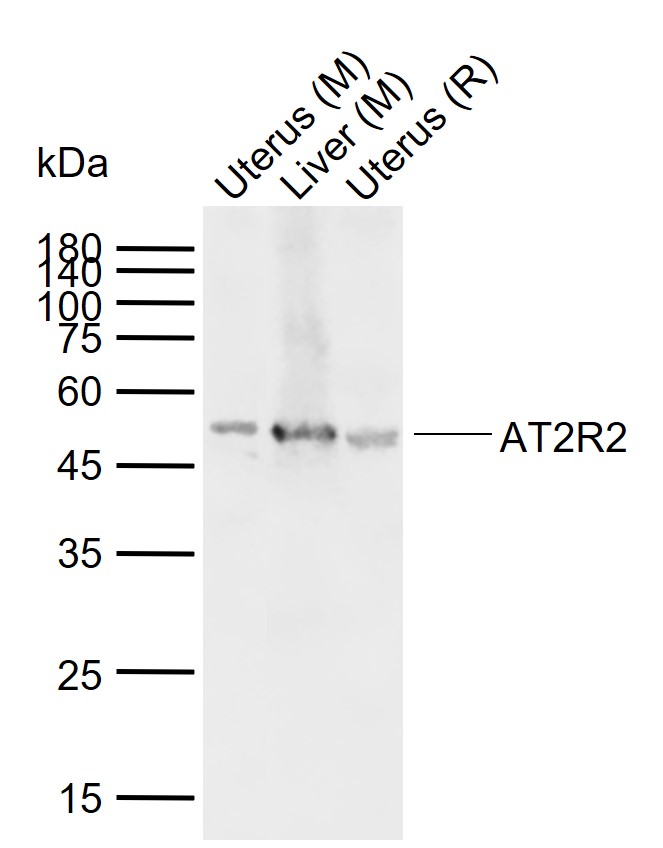
50 kDa
浓度
1mg/ml
储存液
0.01M TBS (pH7.4) with 1% BSA, 0.02% Proclin300 and 50% Glycerol.
研究领域
SWISS
Gene ID
保存条件
Shipped at 4℃. Store at -20℃ for one year. Avoid repeated freeze/thaw cycles.
注意事项
This product as supplied is intended for research use only, not for use in human, therapeutic or diagnostic applications.
数据库链接
背景资料
Angiotensin II (Ang II) is an important physiological effector of blood pressure and volume regulation through vasoconstriction, aldosterone release, sodium uptake and thirst stimulation. Although Ang II interacts with two types of cell surface receptors, AT1 and AT2, most of the major cardiovascular effects seem to be mediated through AT1. Molecular cloning of the AT1 protein has shown it to be a member of the G protein-associated seven transmembrane protein receptor family. Ang II treatment of cells results in activation of several signal transduction pathways as evidenced by tyrosine phosphorylation of several proteins and induction of others. PLC?is phosphorylated after 30 seconds of treatment with Angiotensin II, indicating this as an early signal transduction event. Ang II treatment also stimulates phosphorylation of Shc, FAK and MAP kinases, and induces MKP-1, indicating stimulation of growth factor pathways. Ang II stimulation through AT1 has been shown to activate the JAK/Stat pathway involving a direct interaction between JAK2 and AT1 as demonstrated by coimmunoprecipitation. The AT1 receptor has no cytoplasmic kinase domain, but is able to function as a substrate for Src kinases and has several putative phosphorylation sites.
产品应用
| 应用 | 已检合格种属 | 预测种属 | 推荐稀释比例 |
|---|---|---|---|
| WB | Mouse, Rat | Human, Pig, Sheep, Dog, Horse | 1:500-2000 |
交叉反应
交叉反应: Mouse, Rat (predicted: Human, Pig, Sheep, Dog, Horse)
相关产品
暂无相关产品
靶标
基因名
AGTR2
蛋白名
Type-2 angiotensin II receptor
亚基
Interacts with MTUS1.
亚细胞定位
Cell membrane.
组织特异性
In adult, highly expressed in myometrium with lower levels in adrenal gland and fallopian tube. Very highly expressed in fetal kidney and intestine.
疾病
Defects in AGTR2 are the cause of mental retardation X-linked type 88 (MRX88) [MIM:300852]. Mental retardation is characterized by significantly below average general intellectual functioning associated with impairments in adaptative behavior and manifested during the developmental period.
相似性
Belongs to the G-protein coupled receptor 1 family.
功能
Receptor for angiotensin II. Cooperates with MTUS1 to inhibit ERK2 activation and cell proliferation.
同靶标产品
相关文献
提示: 发表研究结果有使用 bs-2133R 时请让我们知道,以便我们可以引用参考文章。作为回馈,资料提供者将获得我们送上的小礼品。
具体参考文献:bs-2133R 被引用于1文献中