TRPM5 Rabbit pAb (一抗) | Bioss
货号:bs-23624R
产品详情
相关标记
相关产品
相关文献
常见问题
概述
产品编号
bs-23624R
产品类型
宠物抗体、农牧业/家禽抗体、离子通道抗体
英文名称
TRPM5 Rabbit pAb
中文名称
瞬时受体电位离子通道蛋白5抗体(M亚家族)
英文别名
LTRPC5; MTR1; 9430099A16Rik; LTrpC-5; TRPM5_HUMAN; TRPM5; Long transient receptor potential channel 5 (LTrpC-5 | LTrpC5); MLSN1- and TRP-related gene 1 protein; TRPM5_MOUSE; transient receptor potential cation channel subfamily M member 5; transient receptor potential cation channel, subfamily M, member 5
抗体来源
Rabbit
免疫原
KLH conjugated synthetic peptide derived from human TRPM5: 311-410/1165 <Cytoplasmic>
亚型
IgG
性状
Liquid
纯化方法
affinity purified by Protein A
克隆类型
Polyclonal
理论分子量
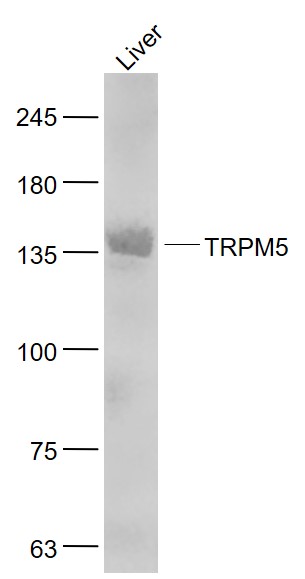
131 kDa
检测分子量
135 kDa
浓度
1mg/ml
储存液
0.01M TBS (pH7.4) with 1% BSA, 0.02% Proclin300 and 50% Glycerol.
研究领域
SWISS
Gene ID
保存条件
Shipped at 4℃. Store at -20℃ for one year. Avoid repeated freeze/thaw cycles.
注意事项
This product as supplied is intended for research use only, not for use in human, therapeutic or diagnostic applications.
数据库链接
背景资料
Voltage-modulated Ca(2+)-activated, monovalent cation channel (VCAM) that mediates a transient membrane depolarization and plays a central role in taste transduction. Monovalent-specific, non-selective cation channel that mediates the transport of Na(+), K(+) and Cs(+) ions equally well. Activated directly by increases in intracellular Ca(2+), but is impermeable to it. Gating is voltage-dependent and displays rapid activation and deactivation kinetics upon channel stimulation even during sustained elevations in Ca(2+). Also activated by a fast intracellular Ca(2+) increase in response to inositol 1,4,5-triphosphate-producing receptor agonists. The channel is blocked by extracellular acidification. External acidification has 2 effects, a fast reversible block of the current and a slower irreversible enhancement of current inactivation. Is a highly temperature-sensitive, heat activated channel showing a steep increase of inward currents at temperatures between 15 and 35 degrees Celsius. Heat activation is due to a shift of the voltage-dependent activation curve to negative potentials. Activated by arachidonic acid in vitro. May be involved in perception of bitter, sweet and umami tastes. May also be involved in sensing semiochemicals.
产品应用
| 应用 | 已检合格种属 | 预测种属 | 推荐稀释比例 |
|---|---|---|---|
| WB | Mouse | Human, Rat, Cow, Chicken, Dog, Horse | 1:500-2000 |
交叉反应
交叉反应: Mouse (predicted: Human, Rat, Cow, Chicken, Dog, Horse)
相关产品
暂无相关产品
靶标
基因名
TRPM5
蛋白名
Transient receptor potential cation channel subfamily M member 5
亚细胞定位
Cell membrane
组织特异性
Strongly expressed in fetal brain, liver and kidney, and in adult prostate, testis, ovary, colon and peripheral blood leukocytes. Also expressed in a large proportion of Wilms' tumors and rhabdomyosarcomas. In monochromosomal cell lines shows exclusive paternal expression.
相似性
Belongs to the transient receptor (TC 1.A.4) family. LTrpC subfamily. TRPM5 sub-subfamily.
功能
Voltage-modulated Ca(2+)-activated, monovalent cation channel (VCAM) that mediates a transient membrane depolarization and plays a central role in taste transduction. Monovalent-specific, non-selective cation channel that mediates the transport of Na(+), K(+) and Cs(+) ions equally well. Activated directly by increases in intracellular Ca(2+), but is impermeable to it. Gating is voltage-dependent and displays rapid activation and deactivation kinetics upon channel stimulation even during sustained elevations in Ca(2+). Also activated by a fast intracellular Ca(2+) increase in response to inositol 1,4,5-triphosphate-producing receptor agonists. The channel is blocked by extracellular acidification. External acidification has 2 effects, a fast reversible block of the current and a slower irreversible enhancement of current inactivation. Is a highly temperature-sensitive, heat activated channel showing a steep increase of inward currents at temperatures between 15 and 35 degrees Celsius. Heat activation is due to a shift of the voltage-dependent activation curve to negative potentials. Activated by arachidonic acid in vitro. May be involved in perception of bitter, sweet and umami tastes. May also be involved in sensing semiochemicals.
同靶标产品
相关文献
提示: 发表研究结果有使用 bs-23624R 时请让我们知道,以便我们可以引用参考文章。作为回馈,资料提供者将获得我们送上的小礼品。
具体参考文献:bs-23624R 被引用于1文献中