PSG3 Rabbit pAb (一抗) | Bioss
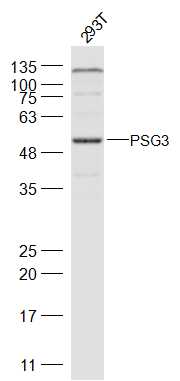
货号:bs-19454R
产品详情
相关标记
相关产品
相关文献
常见问题
概述
产品编号
bs-19454R
英文名称
PSG3 Rabbit pAb
中文名称
妊娠特异性糖蛋白3抗体
英文别名
PSG3_HUMAN; PSG3; PS-beta-G-3; PSBG-3; Pregnancy-specific glycoprotein 3; Carcinoembryonic antigen SG5;
抗体来源
Rabbit
免疫原
KLH conjugated synthetic peptide derived from human PSG3: 351-428/428
亚型
IgG
性状
Liquid
纯化方法
affinity purified by Protein A
克隆类型
Polyclonal
理论分子量
45 kDa
检测分子量
55 kDa
浓度
1mg/ml
储存液
0.01M TBS (pH7.4) with 1% BSA, 0.02% Proclin300 and 50% Glycerol.
研究领域
SWISS
Gene ID
保存条件
Shipped at 4℃. Store at -20℃ for one year. Avoid repeated freeze/thaw cycles.
注意事项
This product as supplied is intended for research use only, not for use in human, therapeutic or diagnostic applications.
背景资料
The human pregnancy-specific glycoproteins (PSGs) are a family of proteins that are synthesized in large amounts by placental trophoblasts and released into the maternal circulation during pregnancy. Molecular cloning and analysis of several PSG genes has indicated that the PSGs form a subgroup of the carcinoembryonic antigen (CEA) gene family, which belongs to the immunoglobulin superfamily of genes. Members of the CEA family consist of a single N domain, with structural similarity to the immunoglobulin variable domains, followed by a variable number of immunoglobulin constant-like A and/or B domains. Most PSGs have an arg-gly-asp (RGD) motif, which has been shown to function as an adhesion recognition signal for several integrins, in the N-terminal domain (summary by Teglund et al., 1994 [PubMed 7851896]). For additional general information about the PSG gene family, see PSG1 (MIM 176390).[supplied by OMIM, Oct 2009]
产品应用
| 应用 | 已检合格种属 | 预测种属 | 推荐稀释比例 |
|---|---|---|---|
| WB | Human | 1:500-2000 |
交叉反应
交叉反应: Human
相关产品
暂无相关产品
靶标
基因名
PSG3
蛋白名
Pregnancy-specific beta-1-glycoprotein 3
亚细胞定位
Secreted
组织特异性
PSBG are produced in high quantity during pregnancy.
同靶标产品
相关文献
提示: 发表研究结果有使用 bs-19454R 时请让我们知道,以便我们可以引用参考文章。作为回馈,资料提供者将获得我们送上的小礼品。