phospho-Mst1(Thr183) + Mst2(Thr180) Rabbit pAb (一抗) | Bioss
货号:bs-3294R
产品详情
相关标记
相关产品
相关文献
常见问题
概述
产品编号
bs-3294R
产品类型
磷酸化抗体、宠物抗体、农牧业/家禽抗体
英文名称
phospho-Mst1(Thr183) + Mst2(Thr180) Rabbit pAb
中文名称
磷酸化蛋白激酶MST抗体
英文别名
KRS2; MST1; YSK3; Kas-2; STK4_HUMAN; STK4; Mammalian STE20-like protein kinase 1 (MST-1); STE20-like kinase MST1; Serine/threonine-protein kinase Krs-2; 2.7.11.1; STK4_MOUSE; serine/threonine kinase 4; mammalian sterile 20-like 1; yeast Ste20-like; kinase responsive to stress 2; hippo (Drosophila) homolog; MST1 & MST2 (phospho-T183/T180); p-MST1 & MST2; phospho-MST1 & MST2; MST1 & MST2 (phospho-Thr183/Thr180)
抗体来源
Rabbit
免疫原
KLH conjugated Synthesised phosphopeptide derived from human Mst1 around the phosphorylation site of Thr183: RN(p-T)VI
亚型
IgG
性状
Liquid
纯化方法
affinity purified by Protein A
克隆类型
Polyclonal
理论分子量
19/37/56 kDa
检测分子量
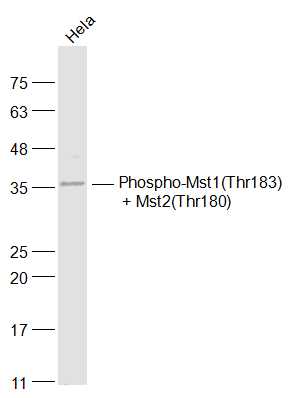
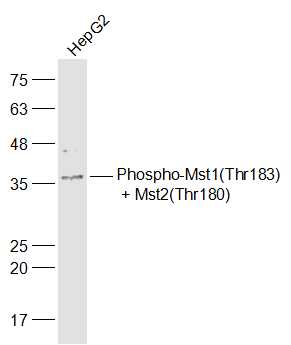
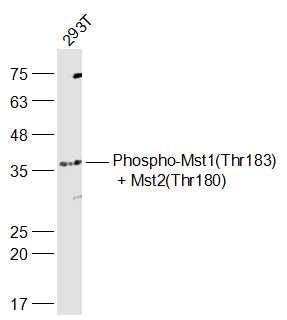
37 kDa
浓度
1mg/ml
储存液
0.01M TBS (pH7.4) with 1% BSA, 0.02% Proclin300 and 50% Glycerol.
研究领域
SWISS
Gene ID
保存条件
Shipped at 4℃. Store at -20℃ for one year. Avoid repeated freeze/thaw cycles.
注意事项
This product as supplied is intended for research use only, not for use in human, therapeutic or diagnostic applications.
数据库链接
产品介绍
蛋白激酶MST(Mammalian Sterile20-like Kinase) 是各种组织均有表达的丝氨酸/苏氨酸(Serine/Threonine)蛋白激酶。属于人丝氨酸/苏氨酸激酶的哺乳动物STE20样激酶(MST),MST1和MST2在caspase蛋白酶激活的细胞凋亡的上游和下游都起作用。
细胞凋亡中MST1被caspase蛋白酶切割和激活,能诱导细胞凋亡形态上的改变如染色质凝聚。哺乳动物STE20样激酶2 (Mst2) 与Mst1蛋白激酶很相似,有近90%的同源性。
细胞凋亡中MST1被caspase蛋白酶切割和激活,能诱导细胞凋亡形态上的改变如染色质凝聚。哺乳动物STE20样激酶2 (Mst2) 与Mst1蛋白激酶很相似,有近90%的同源性。
背景资料
The protein encoded by this gene is a cytoplasmic kinase that is structurally similar to the yeast Ste20p kinase, which acts upstream of the stress-induced mitogen-activated protein kinase cascade. The encoded protein can phosphorylate myelin basic protein and undergoes autophosphorylation. A caspase-cleaved fragment of the encoded protein has been shown to be capable of phosphorylating histone H2B. The particular phosphorylation catalyzed by this protein has been correlated with apoptosis, and it's possible that this protein induces the chromatin condensation observed in this process. [provided by RefSeq, Jul 2008]
产品应用
| 应用 | 已检合格种属 | 预测种属 | 推荐稀释比例 |
|---|---|---|---|
| WB | Human | Mouse, Rat, Rabbit, Cow, Chicken, Dog, Horse | 1:500-2000 |
交叉反应
交叉反应: Human (predicted: Mouse, Rat, Rabbit, Cow, Chicken, Dog, Horse)
相关产品
暂无相关产品
靶标
基因名
STK4
蛋白名
Serine/threonine-protein kinase 4
亚基
Homodimer; mediated via the coiled-coil region. Interacts with NORE1, which inhibits autoactivation. Interacts with and stabilizes SAV1. Interacts with RASSF1. Interacts with FOXO3. Interacts with RASSF2 (via SARAH domain). Interacts with AR, PKB/AKT1, TNNI3 and SIRT1.
亚细胞定位
Cytoplasm. Nucleus. Note=The caspase-cleaved form cycles between the nucleus and cytoplasm.
组织特异性
Expressed in prostate cancer and levels increase from the normal to the malignant state (at protein level). Ubiquitously expressed.
翻译后修饰
Autophosphorylated on serine and threonine residues. Phosphorylation at Thr-120 and Thr-387 by PKB/AKT1, leads to inhibition of its: kinase activity, nuclear translocation and autophosphorylation at Thr-183. It also diminishes its cleavage by caspases and its ability to phosphorylate FOXO3.
Proteolytically cleaved by caspase-3 during apoptosis at Asp-326 and Asp-349 resulting in a 37 kDa or a 39 kDa subunit respectively. The 39 kDa subunit is further cleaved into the 37 kDa form. Proteolytic cleavage results in kinase activation and nuclear translocation of the truncated form (MST1/N). It is less likely that cleavage at Asp-349 is a prerequisite for activation as this site is not conserved in the murine ortholog.
Proteolytically cleaved by caspase-3 during apoptosis at Asp-326 and Asp-349 resulting in a 37 kDa or a 39 kDa subunit respectively. The 39 kDa subunit is further cleaved into the 37 kDa form. Proteolytic cleavage results in kinase activation and nuclear translocation of the truncated form (MST1/N). It is less likely that cleavage at Asp-349 is a prerequisite for activation as this site is not conserved in the murine ortholog.
疾病
T-cell immunodeficiency, recurrent infections, and autoimmunity with or without cardiac malformations (TIIAC) [MIM:614868]: A primary T-cell immunodeficiency syndrome characterized by progressive loss of naive T cells, recurrent bacterial, viral, and fungal infections, warts, and abscesses, autoimmune manifestations, and cardiac malformations, including atrial septal defect. Note=The disease is caused by mutations affecting the gene represented in this entry.
相似性
Belongs to the protein kinase superfamily. STE Ser/Thr protein kinase family. STE20 subfamily.
Contains 1 protein kinase domain.
Contains 1 SARAH domain.
Contains 1 protein kinase domain.
Contains 1 SARAH domain.
功能
Stress-activated, pro-apoptotic kinase which, following caspase-cleavage, enters the nucleus and induces chromatin condensation followed by internucleosomal DNA fragmentation. Key component of the Hippo signaling pathway which plays a pivotal role in organ size control and tumor suppression by restricting proliferation and promoting apoptosis. The core of this pathway is composed of a kinase cascade wherein STK3/MST2 and STK4/MST1, in complex with its regulatory protein SAV1, phosphorylates and activates LATS1/2 in complex with its regulatory protein MOB1, which in turn phosphorylates and inactivates YAP1 oncoprotein and WWTR1/TAZ. Phosphorylation of YAP1 by LATS2 inhibits its translocation into the nucleus to regulate cellular genes important for cell proliferation, cell death, and cell migration. STK3/MST2 and STK4/MST1 are required to repress proliferation of mature hepatocytes, to prevent activation of facultative adult liver stem cells (oval cells), and to inhibit tumor formation (By similarity). Phosphorylates 'Ser-14' of histone H2B (H2BS14ph) during apoptosis. Phosphorylates FOXO3 upon oxidative stress, which results in its nuclear translocation and cell death initiation. Phosphorylates MOBKL1A, MOBKL1B and RASSF2. Phosphorylates TNNI3 (cardiac Tn-I) and alters its binding affinity to TNNC1 (cardiac Tn-C) and TNNT2 (cardiac Tn-T). Phosphorylates FOXO1 on 'Ser-212' and regulates its activation and stimulates transcription of PMAIP1 in a FOXO1-dependent manner. Phosphorylates SIRT1 and inhibits SIRT1-mediated p53/TP53 deacetylation, thereby promoting p53/TP53 dependent transcription and apoptosis upon DNA damage. Acts as an inhibitor of PKB/AKT1. Phosphorylates AR on 'Ser-650' and suppresses its activity by intersecting with PKB/AKT1 signaling and antagonizing formation of AR-chromatin complexes.
同靶标产品
相关文献
提示: 发表研究结果有使用 bs-3294R 时请让我们知道,以便我们可以引用参考文章。作为回馈,资料提供者将获得我们送上的小礼品。
具体参考文献:bs-3294R 被引用于9文献中