r-CPV | VP2 Protein, His (重组蛋白) | Bioss
货号:bs-49051P
产品详情
相关标记
相关产品
相关文献
常见问题
概述
产品编号
bs-49051P
英文名称
r-CPV | VP2 Protein, His
中文名称
重组犬细小病毒VP2蛋白
英文别名
Capsid protein VP2; Coat protein VP2; Canine parvovirus; CAPSD_PAVC; Capsid protein VP2 · Canine parvovirus type 2 (CPV-2); Recombinant CPV2 VP2 protein, His
性状
Lyophilized or Liquid
纯化方法
AC
理论分子量
42 kDa
浓度
Lot depend
储存液
10mM Tris-HCl (pH8.0) with 150mM NaCl.
活性
Not tested
序列
201-584/584
标签
His
纯度
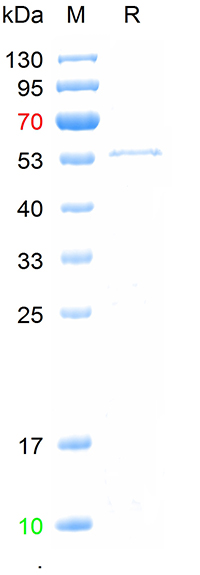
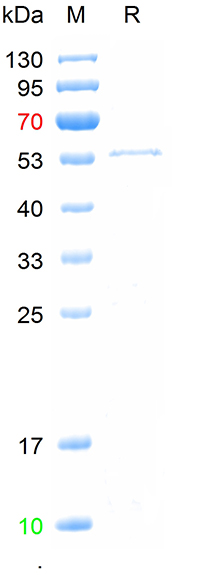
>95% as determined by SDS-PAGE
内毒素
Not analyzed
表达系统
E.coli
复溶
Centrifuge tubes before opening. Reconstituting to a concentration more than 100 μg/ml is recommended. Dissolve the lyophilized protein in distilled water.
保存条件
Stored at -70℃ or -20℃. Avoid repeated freeze/thaw cycles.
注意事项
This product as supplied is intended for research use only, not for use in human, therapeutic or diagnostic applications.
背景资料
Capsid protein self-assembles to form an icosahedral capsid with a T=1 symmetry, about 22 nm in diameter, and consisting of 60 copies of two size variants of the capsid proteins, VP1 and VP2, which differ by the presence of an N-terminal extension in the minor protein VP1. The capsid encapsulates the genomic ssDNA. Capsid proteins are responsible for the attachment to host cell receptor TFRC. This attachment induces virion internalization predominantly through clathrin-endocytosis. Binding to the host receptors also induces capsid rearrangements leading to surface exposure of VP1 N-terminus, specifically its phospholipase A2-like region and nuclear localization signal(s). VP1 N-terminus might serve as a lipolytic enzyme to breach the endosomal membrane during entry into host cell. Intracytoplasmic transport involves microtubules and interaction between capsid proteins and host dynein. Exposure of nuclear localization signal probably allows nuclear import of capsids.
基因名
CPV-2
蛋白名
Capsid protein VP2
亚基
Interacts with host TFRC.
亚细胞定位
Virion; Host nucleus
相似性
Belongs to the parvoviridae capsid protein family.
功能
Capsid protein self-assembles to form an icosahedral capsid with a T=1 symmetry, about 22 nm in diameter, and consisting of 60 copies of two size variants of the capsid proteins, VP1 and VP2, which differ by the presence of an N-terminal extension in the minor protein VP1. The capsid encapsulates the genomic ssDNA. Capsid proteins are responsible for the attachment to host cell receptor TFRC. This attachment induces virion internalization predominantly through clathrin-endocytosis. Binding to the host receptors also induces capsid rearrangements leading to surface exposure of VP1 N-terminus, specifically its phospholipase A2-like region and nuclear localization signal(s). VP1 N-terminus might serve as a lipolytic enzyme to breach the endosomal membrane during entry into host cell. Intracytoplasmic transport involves microtubules and interaction between capsid proteins and host dynein. Exposure of nuclear localization signal probably allows nuclear import of capsids.
相关产品
暂无相关产品