r-FMDV | VP1 Protein, SUMO&His (重组蛋白) | Bioss
货号:bs-10815P
产品详情
相关标记
相关产品
相关文献
常见问题
概述
产品编号
bs-10815P
英文名称
r-FMDV | VP1 Protein, SUMO&His
中文名称
重组口蹄疫病毒A型VP1重组蛋白
英文别名
FMDV VP1; foot and mouth disease virus; Foot-and-mouth disease virus-type Asia 1; Foot-and-mouth disease virus-type Asia 1; VP1 protein; FMDV Polyprotein (VP1 protein); Recombinant FMDV VP1 protein, Sumo & His
性状
Lyophilized or Liquid
纯化方法
AC
理论分子量
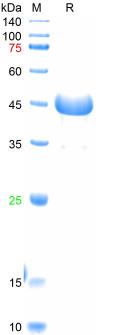
45 kDa
检测分子量
45 kDa
浓度
Lot depend
储存液
PBS (pH7.4).
活性
Not tested
序列
1-209/209
标签
Sumo & His
纯度
>95% as determined by SDS-PAGE
内毒素
Not analyzed
表达系统
E.coli
复溶
Centrifuge tubes before opening. Reconstituting to a concentration more than 100 μg/ml is recommended. Dissolve the lyophilized protein in distilled water.
保存条件
Stored at -70℃ or -20℃. Avoid repeated freeze/thaw cycles.
注意事项
This product as supplied is intended for research use only, not for use in human, therapeutic or diagnostic applications.
数据库链接
产品介绍
口蹄疫是牛、羊、猪等的一种急性、热性传染病,人也可感染,是一种人兽患病。猪口蹄疫的临床特征是在蹄冠、趾间、蹄踵皮肤发生水疱和烂斑,部病猪口腔粘膜和鼻盘也有同样变化。有一种单纯性猪口蹄疫,只引起猪发病,牛、羊极少感染发病,其症状和一般口蹄疫相同。口蹄疫的病原体是口蹄疫病毒,为7个主型,即甲型(A型)、乙型(O型)、丙型(C型)、南非1型、南非2型、南非3型和亚洲1型,其中以甲型和乙型布最广,危害最大,单纯性猪口蹄疫是由乙型病毒所引起,以各型病毒接种动物,只对本型产生免疫力,没有交叉保护作用。
背景资料
The foot-and-mouth disease virus (FMDV) is the pathogen that causes foot-and-mouth disease. It is a picornavirus, the prototypical member of the Aphthovirus genus. The disease, which causes vesicles (blisters) in the mouth and feet of bovids, suids, ovids, caprids and other cloven-hoofed animals is highly infectious and a major plague of animal farming. The virus particle (25-30 nm) has an icosahedral capsid made of protein, without envelope, containing a single strand of ribonucleic acid (RNA) containing a positive encoding of its genome. When the virus comes in contact with the membrane of a host cell, it binds to a receptor site and triggers a folding-in of the membrane. Once the virus is inside the host cell, the capsid dissolves, and the RNA gets replicated, and translated into viral proteins by the cell's ribosomes using a cap-independent mechanism driven by the internal ribosome entry site element. The foot-and-mouth disease virus occurs in seven major serotypes: O, A, C, SAT-1, SAT-2, SAT-3, and Asia-1. These serotypes show some regionality, and the O serotype is most common.
蛋白名
Genome polyprotein
亚细胞定位
Host cytoplasm.
相关产品
暂无相关产品
同靶标产品
相关文献
具体参考文献:bs-10815P 被引用于2文献中