phospho-14-3-3 theta (Ser232) Rabbit pAb (一抗) | Bioss
货号:bs-13774R
产品详情
相关标记
相关产品
相关文献
常见问题
概述
产品编号
bs-13774R
产品类型
磷酸化抗体、农牧业/家禽抗体
英文名称
phospho-14-3-3 theta (Ser232) Rabbit pAb
中文名称
磷酸化14-3-3 τ抗体
英文别名
14-3-3; 1C5; HS1; 2900018K03Rik; an; mKIAA1633; 2700028P07Rik; 14-3-3t; 1433T_CHICK; YWHAQ; 1433T_BOVIN; 1433T_HUMAN; 14-3-3 protein T-cell; 14-3-3 protein tau; Protein HS1; 1433T_MOUSE; 1433T_RAT; tyrosine 3-monooxygenase/tryptophan 5-monooxygenase activation protein theta; tyrosine 3-monooxygenase/tryptophan 5-monooxygenase activation protein, theta polypeptide; protein, theta; protein tau; 14-3-3 theta; YWHAQ | 14-3-3 theta (phospho-S232); p-14-3-3 theta; phospho-14-3-3 theta; p-YWHAQ; YWHAQ | 14-3-3 theta (phospho-Ser232)
抗体来源
Rabbit
免疫原
KLH conjugated synthesised phosphopeptide derived from human 14-3-3 Tau around the phosphorylation site of Ser232: SD(p-S)AG
亚型
IgG
性状
Liquid
纯化方法
affinity purified by Protein A
克隆类型
Polyclonal
理论分子量
28 kDa
浓度
1mg/ml
储存液
0.01M TBS (pH7.4) with 1% BSA, 0.02% Proclin300 and 50% Glycerol.
SWISS
Gene ID
保存条件
Shipped at 4℃. Store at -20℃ for one year. Avoid repeated freeze/thaw cycles.
注意事项
This product as supplied is intended for research use only, not for use in human, therapeutic or diagnostic applications.
数据库链接
背景资料
This gene product belongs to the 14-3-3 family of proteins which mediate signal transduction by binding to phosphoserine-containing proteins. This highly conserved protein family is found in both plants and mammals, and this protein is 99% identical to the mouse and rat orthologs. This gene is upregulated in patients with amyotrophic lateral sclerosis. It contains in its 5' UTR a 6 bp tandem repeat sequence which is polymorphic, however, there is no correlation between the repeat number and the disease. [provided by RefSeq, Jul 2008]
产品应用
| 应用 | 已检合格种属 | 预测种属 | 推荐稀释比例 |
|---|---|---|---|
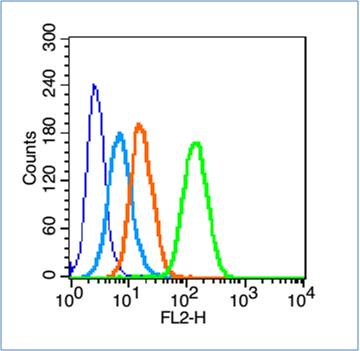
| Flow-Cyt | Human | Mouse, Rat, Pig, Sheep, Cow, Horse | 1μg/Test |
交叉反应
交叉反应: Human (predicted: Mouse, Rat, Pig, Sheep, Cow, Horse)
相关产品
暂无相关产品
靶标
基因名
YWHAQ
蛋白名
14-3-3 protein theta
亚基
Homodimer. Interacts with CDK16. Interacts with RGS7 (phosphorylated form) (PubMed:10862767). Interacts with SSH1. Interacts with CDKN1B ('Thr-198' phosphorylated form); the interaction translocates CDKN1B to the cytoplasm. Interacts with GAB2. Interacts with the 'Ser-241' phosphorylated form of PDPK1. Interacts with the 'Thr-369' phosphorylated form of DAPK2 (PubMed:26047703). Interacts with PI4KB, TBC1D22A and TBC1D22B (PubMed:23572552). Interacts with SLITRK1 (PubMed:19640509). Interacts with RIPOR2 isoform 2 (PubMed:25588844). Interacts with INAVA; the interaction increases upon PRR (pattern recognition receptor) stimulation and is required for cellular signaling pathway activation and cytokine secretion (PubMed:28436939).
亚细胞定位
Cytoplasm. In neurons, axonally transported to the nerve terminals.
组织特异性
Abundantly expressed in brain, heart and pancreas, and at lower levels in kidney and placenta. Up-regulated in the lumbar spinal cord from patients with sporadic amyotrophic lateral sclerosis (ALS) compared with controls, with highest levels of expression in individuals with predominant lower motor neuron involvement.
翻译后修饰
Ser-232 is probably phosphorylated by CK1.
相似性
Belongs to the 14-3-3 family.
功能
Adapter protein implicated in the regulation of a large spectrum of both general and specialized signaling pathways. Binds to a large number of partners, usually by recognition of a phosphoserine or phosphothreonine motif. Binding generally results in the modulation of the activity of the binding partner. Negatively regulates the kinase activity of PDPK1.
同靶标产品
相关文献
提示: 发表研究结果有使用 bs-13774R 时请让我们知道,以便我们可以引用参考文章。作为回馈,资料提供者将获得我们送上的小礼品。