phospho-Mst2 (Thr180) Rabbit pAb (一抗) | Bioss
货号:bs-4634R
产品详情
相关标记
相关产品
相关文献
常见问题
概述
产品编号
bs-4634R
产品类型
磷酸化抗体
英文名称
phospho-Mst2 (Thr180) Rabbit pAb
中文名称
磷酸化蛋白激酶MST2抗体
英文别名
KRS1; MST2; KRS2; MST1; YSK3; STK4_HUMAN; STK4; Mammalian STE20-like protein kinase 1 (MST-1); STE20-like kinase MST1; Serine/threonine-protein kinase Krs-2; 2.7.11.1; STK3_HUMAN; STK3; Mammalian STE20-like protein kinase 2 (MST-2); STE20-like kinase MST2; Serine/threonine-protein kinase Krs-1; STK3_RAT; serine/threonine kinase 3; serine/threonine kinase 3 (Ste20, yeast homolog); hippo (Drosophila) homolog; STK3 | Mst2 (phospho-T180); p-Mst2; phospho-Mst2; p-STK3; STK3 | Mst2 (phospho-Thr180)
抗体来源
Rabbit
免疫原
KLH conjugated Synthesised phosphopeptide derived from human Mst2 around the phosphorylation site of Thr180: RN(p-T)VI
亚型
IgG
性状
Liquid
纯化方法
affinity purified by Protein A
克隆类型
Polyclonal
理论分子量
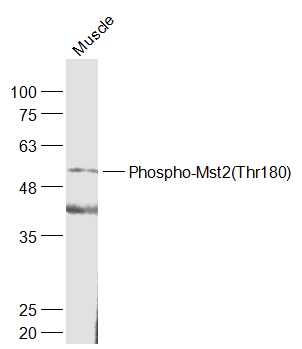
56 kDa
检测分子量
56 kDa
浓度
1mg/ml
储存液
0.01M TBS (pH7.4) with 1% BSA, 0.02% Proclin300 and 50% Glycerol.
研究领域
SWISS
Gene ID
保存条件
Shipped at 4℃. Store at -20℃ for one year. Avoid repeated freeze/thaw cycles.
注意事项
This product as supplied is intended for research use only, not for use in human, therapeutic or diagnostic applications.
数据库链接
产品介绍
蛋白激酶MST(Mammalian Sterile20-like Kinase) 是各种组织均有表达的丝氨酸/苏氨酸(Serine/Threonine)蛋白激酶。属于人丝氨酸/苏氨酸激酶的哺乳动物STE20样激酶(MST),MST1和MST2在caspase蛋白酶激活的细胞凋亡的上游和下游都起作用。
细胞凋亡中MST1被caspase蛋白酶切割和激活,能诱导细胞凋亡形态上的改变如染色质凝聚。哺乳动物STE20样激酶2 (Mst2) 与Mst1蛋白激酶很相似,有近90%的同源性。
背景资料
This gene encodes a serine/threonine protein kinase activated by proapoptotic molecules indicating the encoded protein functions as a growth suppressor. Cleavage of the protein product by caspase removes the inhibitory C-terminal portion. The N-terminal portion is transported to the nucleus where it homodimerizes to form the active kinase which promotes the condensation of chromatin during apoptosis. Multiple transcript variants encoding different isoforms have been found for this gene. [provided by RefSeq, Jan 2012]
产品应用
| 应用 | 已检合格种属 | 预测种属 | 推荐稀释比例 |
|---|---|---|---|
| WB | Mouse | Human, Rat, Rabbit | 1:500-2000 |
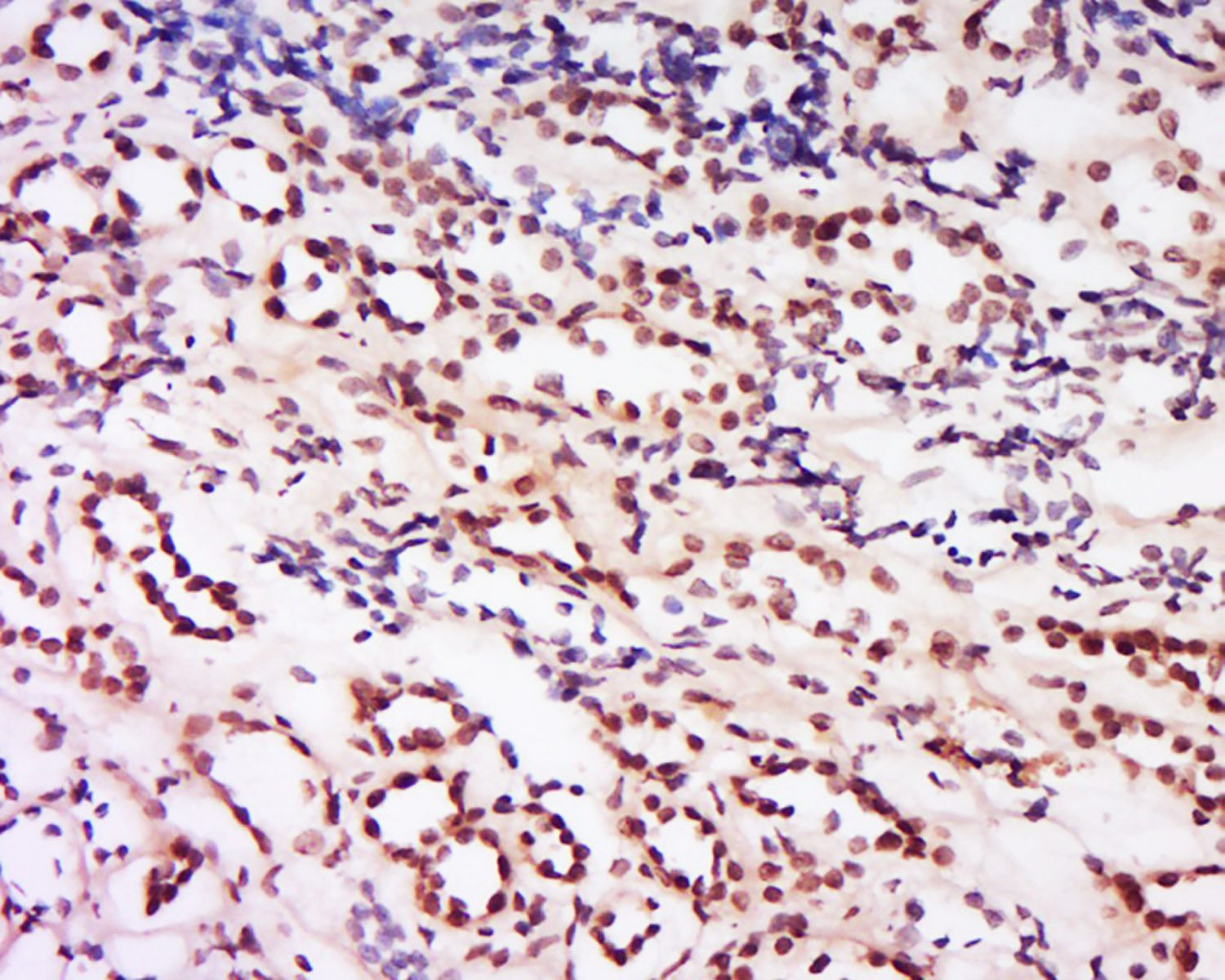
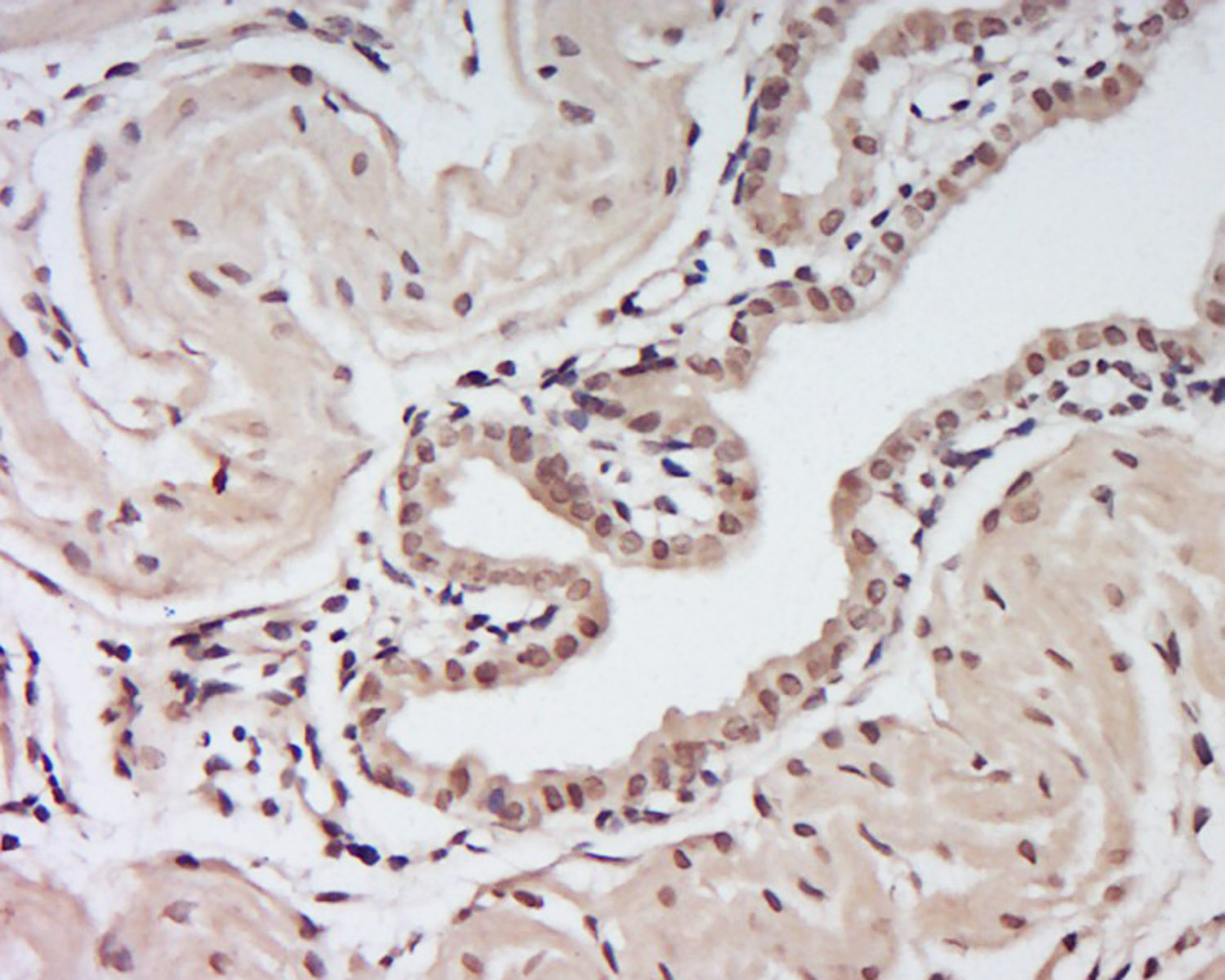
| IHC-P | Human, Mouse | Rat, Rabbit | 1:100-500 |
| IHC-F | Human, Mouse | Rat, Rabbit | 1:100-500 |
| IF | Human, Mouse | Rat, Rabbit | 1:100-500 |
交叉反应
交叉反应: Human, Mouse (predicted: Rat, Rabbit)
相关产品
暂无相关产品
靶标
基因名
STK3
蛋白名
Serine/threonine-protein kinase 3
亚基
Homodimer; mediated via the coiled-coil region. Interacts with NORE1, which inhibits autoactivation. Interacts with and stabilizes SAV1. Interacts with RAF1, which prevents dimerization and phosphorylation. Interacts with RASSF1. Interacts (via SARAH domain) with isoform 1 of NEK2. Interacts with ESR1 only in the presence of SAV1. Interacts with PKB/AKT1. Forms a tripartite complex with MOBKL1B and STK38. Interacts with RASSF2 (via SARAH domain).
亚细胞定位
Cytoplasm. Nucleus. Note: The caspase cleaved form cycles between the nucleus and cytoplasm.
组织特异性
Expressed at high levels in adult kidney, skeletal and placenta tissues and at very low levels in adult heart, lung and brain tissues.
翻译后修饰
Phosphorylation at Thr-117 and Thr-384 by PKB/AKT1, leads to inhibition of its: cleavage, kinase activity, autophosphorylation at Thr-180, binding to RASSF1 and nuclear translocation, and increase in its binding to RAF1.
Proteolytically cleaved by caspase-3 during apoptosis. Proteolytic cleavage results in kinase activation and nuclear translocation of the truncated form (MST1/N).
Proteolytically cleaved by caspase-3 during apoptosis. Proteolytic cleavage results in kinase activation and nuclear translocation of the truncated form (MST1/N).
相似性
Belongs to the protein kinase superfamily. STE Ser/Thr protein kinase family. STE20 subfamily.
Contains 1 protein kinase domain.
Contains 1 SARAH domain.
Contains 1 protein kinase domain.
Contains 1 SARAH domain.
功能
The human serine/threonine kinase, mammalian STE20 like kinase (MST), is considerably homologous to the budding yeast kinases, SPS1 and STE20, throughout their kinase domains. When stably expressed in HeLa cells, MST highly sensitizes the cells to death receptor mediated apoptosis by accelerating caspase 3 activation. These findings suggest that MST1 and MST2 play a role in apoptosis both upstream and downstream of caspase activation. MST1 is cleaved and activated by caspases during apoptosis and is capable of inducing apoptotic morphological changes such as chromatin condensation upon overexpression. Mammalian Sterile 20 Like 2 (MST2) is most similar to the previously identified MST1 protein kinase (78% identity, 88% similarity). Northern analysis indicates that MST2 mRNA is expressed at high levels in adult kidney, skeletal and placental tissues and at very low levels in adult heart, lung, liver and brain tissues. An in vitro kinase assay indicates that MST2 can phosphorylate an exogenous substrate, as well as itself, and phospho amino acid analysis indicates that it is a serine/threonine protein kinase.
同靶标产品
相关文献
提示: 发表研究结果有使用 bs-4634R 时请让我们知道,以便我们可以引用参考文章。作为回馈,资料提供者将获得我们送上的小礼品。