Recombinant human OPRM1 protein, N-GST (重组蛋白) | Bioss
货号:bs-42373P
产品详情
相关标记
相关产品
相关文献
常见问题
概述
产品编号
bs-42373P
英文名称
Recombinant human OPRM1 protein, N-GST
中文名称
重组人µ-型阿片受体蛋白
英文别名
LMOR; MOR 1; mor; MOR1; Mu opiate receptor; mu type opioid receptor; Mu type opioid receptor MOR 1; muOR; Opioid receptor mu 1; Opioid receptor mu; OPRM; OPRM1; OPRM_HUMAN.
性状
Lyophilized or Liquid
纯化方法
AC
理论分子量
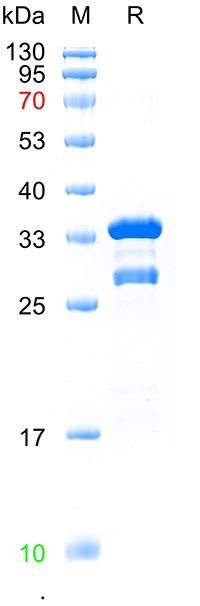
34.9 kDa
浓度
>0.5mg/ml
储存液
PBS (pH=7.4) with 15mM GSH
研究领域
SWISS
Gene ID
序列
339-400/400
物种
Human
标签
N-GST
纯度
>90% as determined by SDS-PAGE
内毒素
Not analyzed
表达系统
E.coli
等电点
5.82
复溶
Centrifuge tubes before opening. Reconstituting to a concentration more than 100 μg/ml is recommended. Dissolve the lyophilized protein in distilled water.
保存条件
Stored at -70℃ or -20℃. Avoid repeated freeze/thaw cycles.
注意事项
This product as supplied is intended for research use only, not for use in human, therapeutic or diagnostic applications.
数据库链接
背景资料
This gene encodes one of three opioid receptors. The mu opioid receptor is the principal target of endogenous opioid peptides and opioid analgesic agents such a s beta-endorphn and enkephalins. The NM_001008503.1:c.118A>G allele had been associated with opioid and alcohol addiction and variations in pain sensitivity but evidence is conflicting. Multiple transcript variants encoding different isoforms have been found for this gene. [provided by RefSeq, Jun 2012]
相关产品
暂无相关产品
靶标
基因名
OPRM1
蛋白名
Mu-type opioid receptor
亚基
Forms homooligomers and heterooligomers with other GPCRs, such as OPRD1, OPRK1, OPRL1, NPFFR2, ADRA2A, SSTR2, CNR1 and CCR5 (probably in dimeric forms). Interacts with PPL; the interaction disrupts agonist-mediated G-protein activation. Interacts (via C-terminus) with DNAJB4 (via C-terminus). Interacts with calmodulin; the interaction inhibits the constitutive activity of OPRM1; it abolishes basal and attenuates agonist-stimulated G-protein coupling. Interacts with FLNA. Interacts with PLD2. Interacts with RANBP9 and WLS. Interacts with GPM6A. Interacts with RTP4. Interacts with SYP and GNAS. Interacts with RGS9, RGS17 and RGS20. Interacts with RGS4. Interacts with PPP1R9B and HINT1.
亚细胞定位
Cell membrane; Multi-pass membrane protein.
组织特异性
Brain. Is expressed in the cerebral cortex, caudate putamen, nucleus accumbens, septal nuclei, thalamus, hippocampus, and habenula. Not detected in cerebellum.
翻译后修饰
Phosphorylated. Differentially phosphorylated in basal and agonist-induced conditions. Agonist-mediated phosphorylation modulates receptor internalization. Phosphorylated by ADRBK1 in a agonist-dependent manner. Phosphorylation at Tyr-166 requires receptor activation, is dependent on non-receptor protein tyrosine kinase Src and results in a decrease in agonist efficacy by reducing G-protein coupling efficiency. Phosphorylated on tyrosine residues; the phosphorylation is involved in agoinist-induced G-protein-indepenedent receptor down-regulation. Phosphorylation at Ser-375 is involved in G-protein-dependent but not beta-arrestin-dependent activation of the ERK pathway.
Ubiquitinated. A basal ubiquitination seems not to be related to degradation. Ubiquitination is increased upon formation of OPRM1:OPRD1 oligomers leading to proteasomal degradation; the ubiquitination is diminished by RTP4. Phosphorylation at Tyr-168 requires receptor activation, is dependent on non-receptor protein tyrosine kinase Src and results in a decrease in agonist efficacy by reducing G-protein coupling efficiency. Phosphorylated on tyrosine residues; the phosphorylation is involved in agoinist-induced G-protein-indepenedent receptor down-regulation. Phosphorylation at Ser-377 is involved in G-protein-dependent but not beta-arrestin-dependent activation of the ERK pathway (By similarity).
Ubiquitinated. A basal ubiquitination seems not to be related to degradation. Ubiquitination is increased upon formation of OPRM1:OPRD1 oligomers leading to proteasomal degradation; the ubiquitination is diminished by RTP4 (By similarity).
Ubiquitinated. A basal ubiquitination seems not to be related to degradation. Ubiquitination is increased upon formation of OPRM1:OPRD1 oligomers leading to proteasomal degradation; the ubiquitination is diminished by RTP4. Phosphorylation at Tyr-168 requires receptor activation, is dependent on non-receptor protein tyrosine kinase Src and results in a decrease in agonist efficacy by reducing G-protein coupling efficiency. Phosphorylated on tyrosine residues; the phosphorylation is involved in agoinist-induced G-protein-indepenedent receptor down-regulation. Phosphorylation at Ser-377 is involved in G-protein-dependent but not beta-arrestin-dependent activation of the ERK pathway (By similarity).
Ubiquitinated. A basal ubiquitination seems not to be related to degradation. Ubiquitination is increased upon formation of OPRM1:OPRD1 oligomers leading to proteasomal degradation; the ubiquitination is diminished by RTP4 (By similarity).
相似性
Belongs to the G-protein coupled receptor 1 family.
功能
Receptor for endogenous opioids such as beta-endorphin and endomorphin. Agonist binding to the receptor induces coupling to an inactive GDP-bound heterotrimeric G-protein complex and subsequent exchange of GDP for GTP in the G-protein alpha subunit leading to dissociation of the G-protein complex with the free GTP-bound G-protein alpha and the G-protein beta-gamma dimer activating downstream cellular effectors. The agonist- and cell type-specific activity is predominantly coupled to pertussis toxin-sensitive G(i) and G(o) G alpha proteins, GNAI1, GNAI2, GNAI3 and GNAO1 isoforms Alpha-1 and Alpha-2, and to a lesser extend to pertussis toxin-insensitive G alpha proteins GNAZ and GNA15. They mediate an array of downstream cellular responses, including inhibition of adenylate cyclase activity and both N-type and L-type calcium channels, activation of inward rectifying potassium channels, mitogen-activated protein kinase (MAPK), phospholipase C (PLC), phosphoinositide/protein kinase (PKC), phosphoinositide 3-kinase (PI3K) and regulation of NF-kappa-B. Also couples to adenylate cyclase stimulatory G alpha proteins. The selective temporal coupling to G-proteins and subsequent signaling can be regulated by RGSZ proteins, such as RGS9, RGS17 and RGS4. Phosphorylation by members of the GPRK subfamily of Ser/Thr protein kinases and association with beta-arrestins is involved in short-term receptor desensitization. Beta-arrestins associate with the GPRK-phosphorylated receptor and uncouple it from the G-protein thus terminating signal transduction. The phosphorylated receptor is internalized through endocytosis via clathrin-coated pits which involves beta-arrestins. The activation of the ERK pathway occurs either in a G-protein-dependent or a beta-arrestin-dependent manner and is regulated by agonist-specific receptor phosphorylation. Acts as a class A G-protein coupled receptor (GPCR) which dissociates from beta-arrestin at or near the plasma membrane and undergoes rapid recycling. Receptor down-regulation pathways are varying with the agonist and occur dependent or independent of G-protein coupling. Endogenous ligands induce rapid desensitization, endocytosis and recycling. Heterooligomerization with other GPCRs can modulate agonist binding, signaling and trafficking properties. Involved in neurogenesis.