CSF1 Rabbit pAb (一抗) | Bioss
货号:bs-4910R
产品详情
相关标记
相关产品
相关文献
常见问题
概述
产品编号
bs-4910R
产品类型
宠物抗体、农牧业/家禽抗体
英文名称
CSF1 Rabbit pAb
中文名称
巨噬细胞克隆刺激因子抗体
英文别名
CSF-1; MCSF; PG-M-CSF; BAP025; Csfm; Mhdabap25; op; CSF1_HUMAN; CSF1; M-CSF; Lanimostim; Proteoglycan macrophage colony-stimulating factor (PG-M-CSF); CSF1_MOUSE; CSF1_RAT;
抗体来源
Rabbit
免疫原
KLH conjugated synthetic peptide derived from human MCSF/M-CSF: 201-300/554 <Extracellular>
亚型
IgG
性状
Liquid
纯化方法
affinity purified by Protein A
克隆类型
Polyclonal
理论分子量
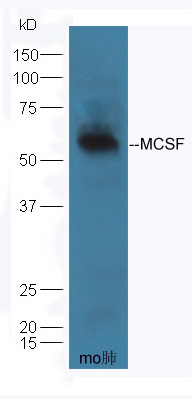
57 kDa
检测分子量
57 kDa
浓度
1mg/ml
储存液
0.01M TBS (pH7.4) with 1% BSA, 0.02% Proclin300 and 50% Glycerol.
研究领域
SWISS
Gene ID
保存条件
Shipped at 4℃. Store at -20℃ for one year. Avoid repeated freeze/thaw cycles.
注意事项
This product as supplied is intended for research use only, not for use in human, therapeutic or diagnostic applications.
数据库链接
产品介绍
M-CSF是促使造血细胞分化成粒细胞与巨噬细胞克隆的重要细胞因子,对正常血细胞的形成与造血细胞 的存活、分化、正常造血功能 的维持具有重要作用,直接与间接增加lak细胞的活性,在人体 的细胞因子网络中占有重要 的地位,目前广泛应用于化.放疗 的辅助治疗中。
目前研究主要应用在免疫缺陷性疾病及病毒性疾病:慢性肝病,尤其是与病毒相关的疾病,因其发病过程涉及免疫细胞与造血系统,有可能成为gm-csf(粒细胞-巨噬细胞克隆刺激因子)应用的新领域。人和小鼠天然M-CSF为糖蛋白,由二硫键连接的同源双体,分子量40~90kDa。人和小鼠M-CSF分子这个区域结构高度保守,其同源性达80%。
目前研究主要应用在免疫缺陷性疾病及病毒性疾病:慢性肝病,尤其是与病毒相关的疾病,因其发病过程涉及免疫细胞与造血系统,有可能成为gm-csf(粒细胞-巨噬细胞克隆刺激因子)应用的新领域。人和小鼠天然M-CSF为糖蛋白,由二硫键连接的同源双体,分子量40~90kDa。人和小鼠M-CSF分子这个区域结构高度保守,其同源性达80%。
背景资料
Four distinct colony-stimulating factors (CSFs) that promote survival, proliferation and differentiation of bone marrow precursor cells have been well characterized: granulocyte macrophage CSF (GMCSF), granulocyte CSF (GCSF), macrophage CSF (MCSF), and Interleukin-3 (IL-3, Multi CSF). Both GMCSF and IL-3 are multipotential growth factors, stimulating proliferation of progenitor cells from more than one hematopoietic lineage. In contrast, GCSF and MCSF are lineage restricted hematopoietic growth factors, stimulating final mitotic divisions and the terminal cellular maturation of the partially differentiated hematopoietic progenitors.
Macrophage CSF, also known as CSF1, is produced by monocytes, fibroblasts and endothelial cells. It stimulates the formation of macrophage colonies, enhances antibody-dependent, cell-mediated cytotoxicity by monocytes and macrophages, and inhibits bone resorption by osetoclasts. Natural human MCSF is a dimeric glycoprotein of 70-90 kD molecular weight, existing in multiple glycosylation forms. It binds to a 165 kD glycoprotein of the receptor tyrosine kinase subclass III, a family that includes the receptors for platelet derived growth factor (PDGF) and stem cell factor (SCF).
Macrophage CSF, also known as CSF1, is produced by monocytes, fibroblasts and endothelial cells. It stimulates the formation of macrophage colonies, enhances antibody-dependent, cell-mediated cytotoxicity by monocytes and macrophages, and inhibits bone resorption by osetoclasts. Natural human MCSF is a dimeric glycoprotein of 70-90 kD molecular weight, existing in multiple glycosylation forms. It binds to a 165 kD glycoprotein of the receptor tyrosine kinase subclass III, a family that includes the receptors for platelet derived growth factor (PDGF) and stem cell factor (SCF).
产品应用
| 应用 | 已检合格种属 | 预测种属 | 推荐稀释比例 |
|---|---|---|---|
| WB | Mouse | Human, Rat, Rabbit, Pig, Cow, Dog | 1:500-2000 |
交叉反应
交叉反应: Mouse (predicted: Human, Rat, Rabbit, Pig, Cow, Dog)
相关产品
暂无相关产品
靶标
基因名
CSF1
蛋白名
Macrophage colony-stimulating factor 1
亚基
Homodimer or heterodimer; disulfide-linked. Interacts with CSF1R.
亚细胞定位
Cell membrane; Single-pass membrane protein. Processed macrophage colony-stimulating factor 1: Secreted, extracellular space.
翻译后修饰
N-glycosylated. The predominant soluble form is a chondroitin sulfate-containing proteoglycan.
疾病
Note=A defect in Csf1 is the cause of osteopetrosis. Osteopetrotic mice (op/op) are severely deficient in mature macrophages and osteoclasts, display failed tooth eruption, and have a restricted capacity for bone remodeling.
功能
Cytokine that plays an essential role in the regulation of survival, proliferation and differentiation of hematopoietic precursor cells, especially mononuclear phagocytes, such as macrophages and monocytes. Promotes the release of proinflammatory chemokines, and thereby plays an important role in innate immunity and in inflammatory processes. Plays an important role in the regulation of osteoclast proliferation and differentiation, the regulation of bone resorption, and is required for normal bone development. Required for normal male and female fertility. Promotes reorganization of the actin cytoskeleton, regulates formation of membrane ruffles, cell adhesion and cell migration. Plays a role in lipoprotein clearance.
同靶标产品
相关文献
提示: 发表研究结果有使用 bs-4910R 时请让我们知道,以便我们可以引用参考文章。作为回馈,资料提供者将获得我们送上的小礼品。
具体参考文献:bs-4910R 被引用于2文献中