Hemoglobin alpha Rabbit pAb (一抗) | Bioss
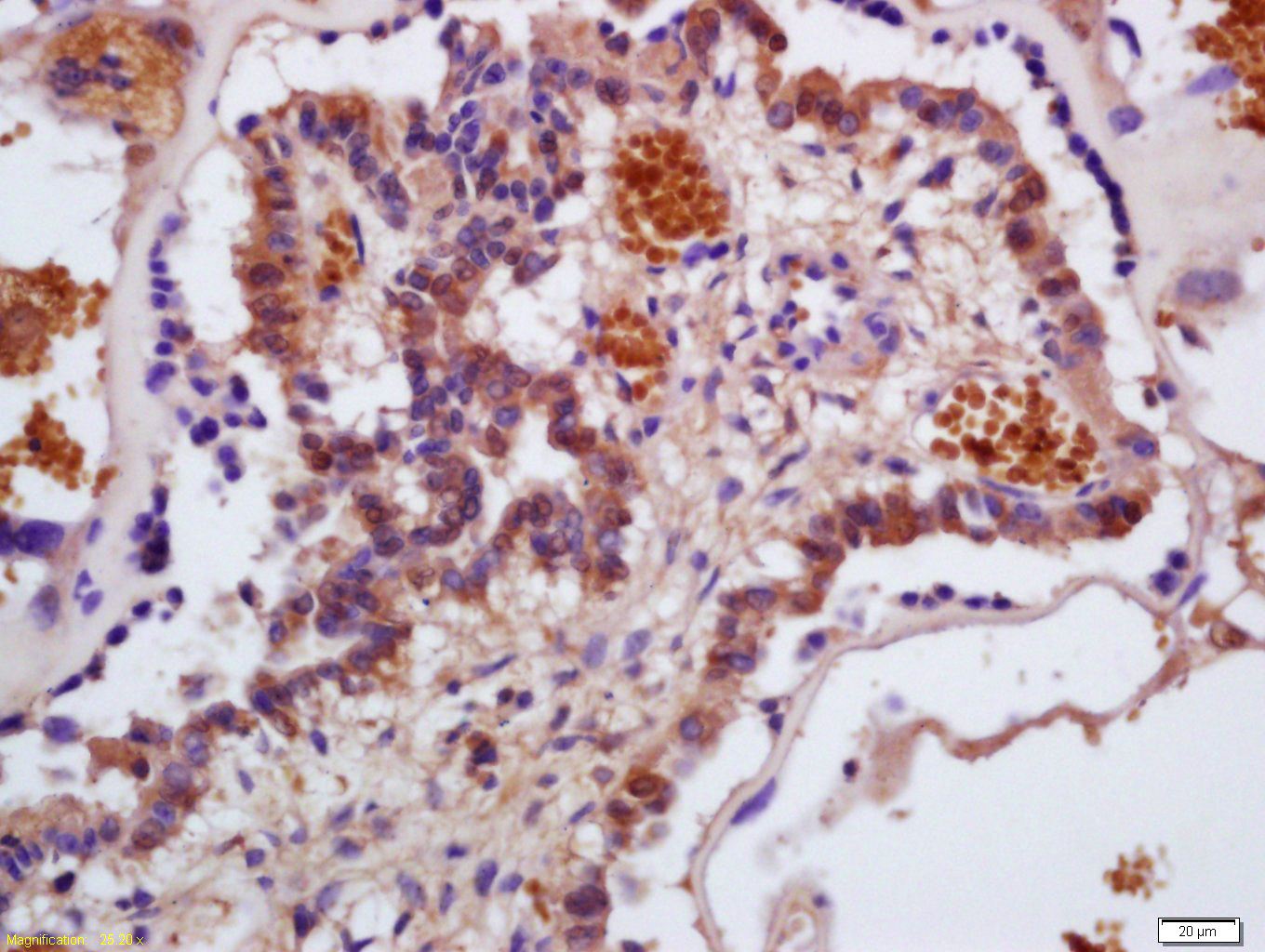
货号:bs-9889R
产品详情
相关标记
相关产品
相关文献
常见问题
概述
产品编号
bs-9889R
产品类型
农牧业/家禽抗体
英文名称
Hemoglobin alpha Rabbit pAb
中文名称
血红蛋白α/Hemoglobin A1c抗体
英文别名
ECYT7; HBA-T3; HBH; METHBA; HBA_HUMAN; HBA1; HBA2; Alpha-globin; Hemoglobin alpha chain; HBA_MOUSE; Hba; Hba-a1; HBA_RAT; Alpha-1/2-globin; Hemoglobin alpha-1/2 chain;
抗体来源
Rabbit
免疫原
KLH conjugated synthetic peptide derived from human Hemoglobin alpha: 1-100/142
亚型
IgG
性状
Liquid
纯化方法
affinity purified by Protein A
克隆类型
Polyclonal
理论分子量
15 kDa
浓度
1mg/ml
储存液
0.01M TBS (pH7.4) with 1% BSA, 0.02% Proclin300 and 50% Glycerol.
研究领域
SWISS
Gene ID
保存条件
Shipped at 4℃. Store at -20℃ for one year. Avoid repeated freeze/thaw cycles.
注意事项
This product as supplied is intended for research use only, not for use in human, therapeutic or diagnostic applications.
产品介绍
IHC没有反馈,保留应用
背景资料
he human alpha globin gene cluster located on chromosome 16 spans about 30 kb and includes seven loci: 5'- zeta - pseudozeta - mu - pseudoalpha-1 - alpha-2 - alpha-1 - theta - 3'. The alpha-2 (HBA2) and alpha-1 (HBA1) coding sequences are identical. These genes differ slightly over the 5' untranslated regions and the introns, but they differ significantly over the 3' untranslated regions. Two alpha chains plus two beta chains constitute HbA, which in normal adult life comprises about 97% of the total hemoglobin; alpha chains combine with delta chains to constitute HbA-2, which with HbF (fetal hemoglobin) makes up the remaining 3% of adult hemoglobin. Alpha thalassemias result from deletions of each of the alpha genes as well as deletions of both HBA2 and HBA1; some nondeletion alpha thalassemias have also been reported. [provided by RefSeq, Jul 2008]
产品应用
| 应用 | 已检合格种属 | 预测种属 | 推荐稀释比例 |
|---|---|---|---|
| IHC-P | Mouse | Human, Sheep, Cow | 1:100-500 |
| IHC-F | Mouse | Human, Sheep, Cow | 1:100-500 |
| IF | Mouse | Human, Sheep, Cow | 1:100-500 |
交叉反应
交叉反应: Mouse (predicted: Human, Sheep, Cow)
相关产品
暂无相关产品
靶标
基因名
HBA1
蛋白名
Hemoglobin subunit alpha
亚基
Heterotetramer of two alpha chains and two beta chains in adult hemoglobin A (HbA); two alpha chains and two delta chains in adult hemoglobin A2 (HbA2); two alpha chains and two epsilon chains in early embryonic hemoglobin Gower-2; two alpha chains and two gamma chains in fetal hemoglobin F (HbF).
亚细胞定位
hemoglobin complex.
组织特异性
Red blood cells.
翻译后修饰
The initiator Met is not cleaved in variant Thionville and is acetylated.
疾病
Defects in HBA1 may be a cause of Heinz body anemias (HEIBAN) [MIM:140700]. This is a form of non-spherocytic hemolytic anemia of Dacie type 1. After splenectomy, which has little benefit, basophilic inclusions called Heinz bodies are demonstrable in the erythrocytes. Before splenectomy, diffuse or punctate basophilia may be evident. Most of these cases are probably instances of hemoglobinopathy. The hemoglobin demonstrates heat lability. Heinz bodies are observed also with the Ivemark syndrome (asplenia with cardiovascular anomalies) and with glutathione peroxidase deficiency.
Defects in HBA1 are the cause of alpha-thalassemia (A-THAL) [MIM:604131]. The thalassemias are the most common monogenic diseases and occur mostly in Mediterranean and Southeast Asian populations. The hallmark of alpha-thalassemia is an imbalance in globin-chain production in the adult HbA molecule. The level of alpha chain production can range from none to very nearly normal levels. Deletion of both copies of each of the two alpha-globin genes causes alpha(0)-thalassemia, also known as homozygous alpha thalassemia. Due to the complete absence of alpha chains, the predominant fetal hemoglobin is a tetramer of gamma-chains (Bart hemoglobin) that has essentially no oxygen carrying capacity. This causes oxygen starvation in the fetal tissues leading to prenatal lethality or early neonatal death. The loss of three alpha genes results in high levels of a tetramer of four beta chains (hemoglobin H), causing a severe and life-threatening anemia known as hemoglobin H disease. Untreated, most patients die in childhood or early adolescence. The loss of two alpha genes results in mild alpha-thalassemia, also known as heterozygous alpha-thalassemia. Affected individuals have small red cells and a mild anemia (microcytosis). If three of the four alpha-globin genes are functional, individuals are completely asymptomatic. Some rare forms of alpha-thalassemia are due to point mutations (non-deletional alpha-thalassemia). The thalassemic phenotype is due to unstable globin alpha chains that are rapidly catabolized prior to formation of the alpha-beta heterotetramers.
Note=Alpha(0)-thalassemia is associated with non-immune hydrops fetalis, a generalized edema of the fetus with fluid accumulation in the body cavities due to non-immune causes. Non-immune hydrops fetalis is not a diagnosis in itself but a symptom, a feature of many genetic disorders, and the end-stage of a wide variety of disorders.
Defects in HBA1 are the cause of hemoglobin H disease (HBH) [MIM:613978]. HBH is a form of alpha-thalassemia due to the loss of three alpha genes. This results in high levels of a tetramer of four beta chains (hemoglobin H), causing a severe and life-threatening anemia. Untreated, most patients die in childhood or early adolescence.
Defects in HBA1 are the cause of alpha-thalassemia (A-THAL) [MIM:604131]. The thalassemias are the most common monogenic diseases and occur mostly in Mediterranean and Southeast Asian populations. The hallmark of alpha-thalassemia is an imbalance in globin-chain production in the adult HbA molecule. The level of alpha chain production can range from none to very nearly normal levels. Deletion of both copies of each of the two alpha-globin genes causes alpha(0)-thalassemia, also known as homozygous alpha thalassemia. Due to the complete absence of alpha chains, the predominant fetal hemoglobin is a tetramer of gamma-chains (Bart hemoglobin) that has essentially no oxygen carrying capacity. This causes oxygen starvation in the fetal tissues leading to prenatal lethality or early neonatal death. The loss of three alpha genes results in high levels of a tetramer of four beta chains (hemoglobin H), causing a severe and life-threatening anemia known as hemoglobin H disease. Untreated, most patients die in childhood or early adolescence. The loss of two alpha genes results in mild alpha-thalassemia, also known as heterozygous alpha-thalassemia. Affected individuals have small red cells and a mild anemia (microcytosis). If three of the four alpha-globin genes are functional, individuals are completely asymptomatic. Some rare forms of alpha-thalassemia are due to point mutations (non-deletional alpha-thalassemia). The thalassemic phenotype is due to unstable globin alpha chains that are rapidly catabolized prior to formation of the alpha-beta heterotetramers.
Note=Alpha(0)-thalassemia is associated with non-immune hydrops fetalis, a generalized edema of the fetus with fluid accumulation in the body cavities due to non-immune causes. Non-immune hydrops fetalis is not a diagnosis in itself but a symptom, a feature of many genetic disorders, and the end-stage of a wide variety of disorders.
Defects in HBA1 are the cause of hemoglobin H disease (HBH) [MIM:613978]. HBH is a form of alpha-thalassemia due to the loss of three alpha genes. This results in high levels of a tetramer of four beta chains (hemoglobin H), causing a severe and life-threatening anemia. Untreated, most patients die in childhood or early adolescence.
相似性
Belongs to the globin family.
功能
Involved in oxygen transport from the lung to the various peripheral tissues.
同靶标产品
相关文献
提示: 发表研究结果有使用 bs-9889R 时请让我们知道,以便我们可以引用参考文章。作为回馈,资料提供者将获得我们送上的小礼品。